Daily Market Digest · Tuesday, October 20, 2026
Rotation day: money leaves tech for safety — as the AI trade's funding question meets megacap earnings week.
Built from the finance podcast transcripts — what the shows actually said, paraphrased, never invented. Sources that weren't available are marked inline.
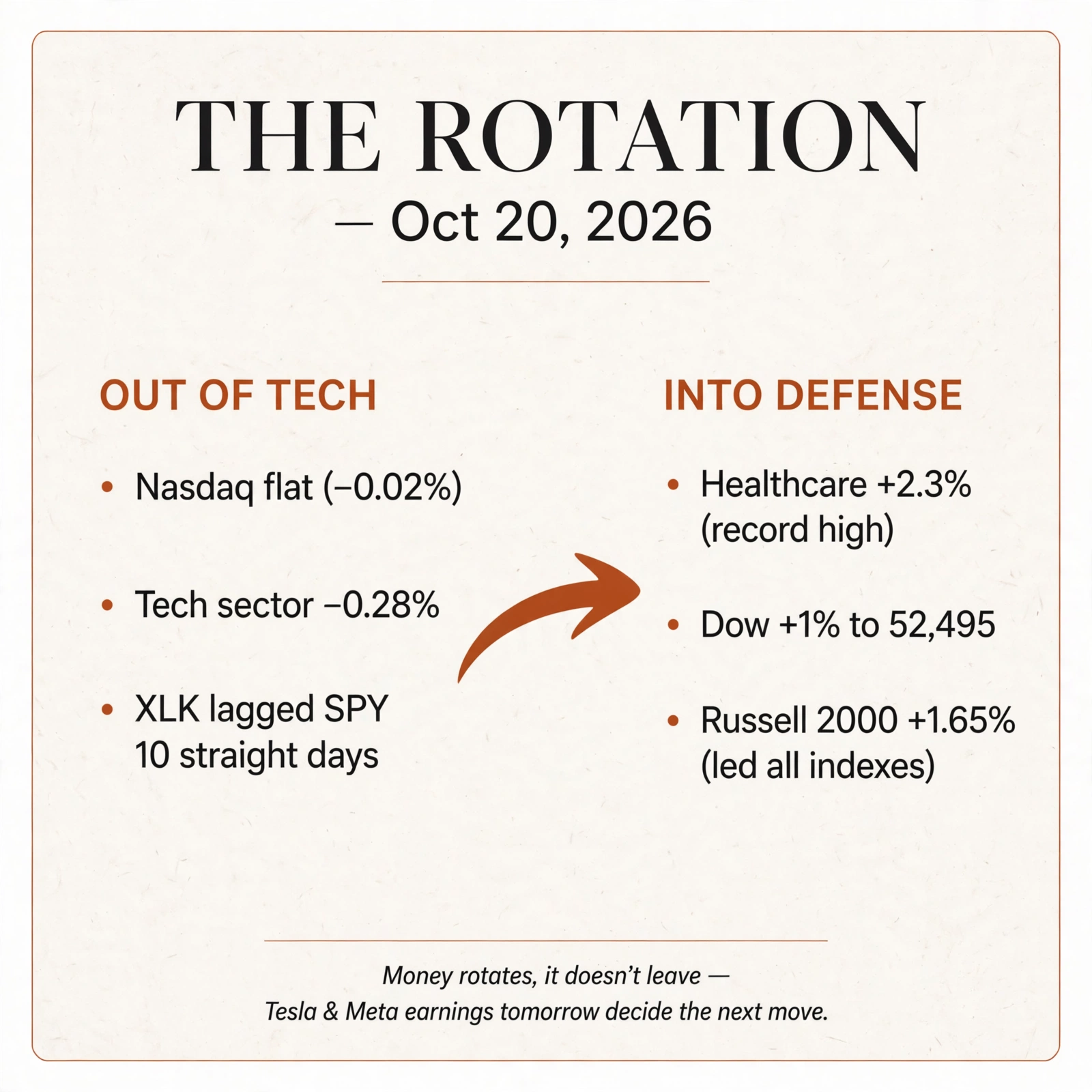
The one thing that matters: Tuesday was a rotation, not a rout — money walked out of tech and into defensives (healthcare +2.3% to a record high, Dow +1% to 52,495, Russell 2000 +1.65%) while the Nasdaq went nowhere. The AI funding debate kept burning: a Korean neocloud just posted the worst-ever IPO debut on the KOSPI (-38% at the open) as the market reprices debt-funded AI buildouts. The tiebreaker arrives this week — SpaceX reported tonight, Tesla and Meta report tomorrow — and the question on the tape is where the next phase of AI capex goes, and how it's financed. Over it all sits the Fed: a skip is the base case at the late-October meeting, but hot inflation keeps a December hike alive.
Bloomberg: Surveillance
"Bloomberg Surveillance 10/20/2026" (TV) — full transcript via YouTube auto-captions. Guests included an AI-infrastructure founder, a Raymond James analyst on the midterms, GM's CFO, and a rotation-focused strategist.
- Cracks in the AI trade deepened: a Korean neocloud tanked 38% on its public debut — the worst first-day IPO ever for a sizable KOSPI listing — and investors are revaluing the whole data-center/AI financing chain. Nscale is in talks with Anthropic on a $45B cloud deal, and CoreWeave was down ~4% premarket.
- Megacap earnings week is the anchor: SpaceX reported tonight (after scheduling it with just two business days' notice), then Tesla and Meta. The tape's questions: how big is the capex, where does it go (AI vs. connectivity), and how is it financed — debt or equity?
- The Fed sits in the dark: blackout period ahead of the decision in about a week. Chair Walsh won't tolerate hot inflation, but the base case remains a skip in October — then potentially more hiking in December, since the inflation data was broad-based.
- The rotation is real: staples were the best-performing sector last week with 75% of constituents making 20-day highs — a defensive lineup (staples, energy, healthcare) replacing the old tech/industrials/financials leadership. For the first time in ~4 years, the "493" are expected to outgrow the Mag 7 next quarter.
- Earnings rewarded the clean: GM announced a $20B buyback but narrowed guidance (-6% on the day); 3M beat and raised its outlook (+6%); RTX and GE also beat. GM's CFO flagged ~$400M of tariff/aluminum/steel inflation hitting in Q3.
- Midterms creep onto the tape: if the takeaway from November is that opposing AI and data centers wins votes, even a Democratic sweep could bring federal AI-regulation bills with veto-proof momentum — a new market volatility source.
- Macro notes: oil eased on reports of a possible US–Iran compromise; Trump said he'd attend a Trump–Putin–Xi denuclearization summit if asked.
The day's market callWatch the hyperscaler capex numbers and the financing fine print — that's what decides whether this is a funding reset or a demand problem. And watch the rotation: defensive leadership holding means the AI trade's stumble is becoming the rest of the market's bid.
Tickers: CRWV, NVDA, TSLA, META, GM, MMM, RTX, GE, XLK
CNBC: Mad Money
"Mad Money 10/20/26 | Audio Only" — full transcript via YouTube auto-captions. A teach-in episode: no stock picks, all rules.
- Watch the bonds, always: "Where are the bonds?" was how Cramer started every day running his hedge fund. The bond market is bigger than the stock market and usually sees what's coming — it flagged the 2000 top and the run-up to the financial crisis while equity investors looked away.
- Bonds are stocks' true competition: when rates go sky-high, dividend stocks sell off because their yields can't compete with risk-free alternatives — unless they've fallen so far they're accidentally high-yielders, which is exactly when Cramer goes hunting.
- The oscillator: sell something to raise cash when the S&P oscillator hits +5; buy when it hits -5 (a bounce is usually due); at -10, "buy everything" — that's where the biggest moves higher come from.
- SPACs remain radioactive: 2020–21 SPACs shipped made-up multi-year forecasts that would've meant prison under real IPO rules — and they let it happen because bankers wanted fees. "Don't believe the hype" on dubious merchandise.
- Be a skeptic of everything you hear — on TV and especially online. Just because someone says it on TV doesn't mean it's true.
The day's market callDiscipline over prediction: keep bond yields in front of you at all times, raise cash into strength, and never chase an IPO-shaped story without reading the financing.
Tickers: (teach-in episode — no names picked)
Fidelity: Market Sense
Weekly — drops Tuesdays.
No new episode this week — latest remains the October 6 edition ("This Has Happened To Stocks 95% Of The Time After Midterms"), covered in the Oct 7 digest.
Schwab: Market Update
Weekdays — the day's written article.
Schwab transcript not up yet — the October 20 edition wasn't retrievable (schwab.com bot wall; search index hadn't picked it up by run time).
Bloomberg: The Big Take
Daily.
No confirmed October 20 main episode found — skipped today rather than summarizing a non-market feature.
CNBC: Fast Money
Skipped — no free caption source (standing rule; never summarize from headlines).