Daily Market Digest · Tuesday, September 29, 2026
The AI story just broke its own script.
Built from tonight's finance podcast transcripts — what the shows actually said, paraphrased, never invented. Sources that weren't available are marked inline.
The one thing that matters: the AI industry spent the day arguing against itself — Anthropic's IPO prospectus devotes 80 of 261 pages to risks including "existential threats," OpenAI is holding back its next model over safety while raising $30B at a $1.4T valuation, and the White House rebranded AI as "superintelligence," calling it "morally binding." Meanwhile the bond vigilantes are back with a vengeance: the 30-year Treasury is at a 24-year high and Ed Yardeni says the 10-year's 5.25% may not be the top — 5.5% or higher is in play. Tuesday's tape barely held: S&P −0.17%, Dow −0.26%, Nasdaq-100 +0.21%, oil off 3.5% to ~$89.
Schwab Market Update
Tuesday, Sept 29 · Morning edition (9:13 a.m. ET) — "Stocks Up Early, Led by Tech, as AI Dominates News" + Schwab Network closing recap. Article text via search-index cache and Schwab Network.
- Closing tape: S&P 500 −0.17%, Dow −0.26%, Nasdaq-100 +0.21%, Russell 2000 −0.35%. WTI crude fell 3.5%+ to about $89. The 10-year Treasury climbed to 5.255%.
- AI dominates the morning: tech led the early session as investors mulled Anthropic's IPO prospectus and OpenAI halting its next-generation model release over safety concerns. Lower yields and oil were a positive backdrop.
- Data parade begins: the August JOLTS report landed Tuesday (consensus 7.2M, barely below July's). Collin Martin (SCFR): if the labor market stays stable, "it just takes pressure away from that side of the mandate and allows the Fed to focus more on inflation." Nonfarm payrolls hit Friday — consensus 84,000, about half of August's tally.
- Monday's overhang: rate-hike odds stayed firm — 70% for an October hike, 58% for another in December, per the CME FedWatch Tool. Higher rates raise borrowing costs for the AI "hyperscalers" driving growth — and inflation.
- Movers: Micron (MU) rallied 1%+ ahead of Wednesday's earnings; Lam Research +3%, KLA +3.9%, Applied Materials +5.2%, SOX +1.32%. Fair Isaac (FICO) slumped nearly 27% — worst in the S&P — on a mortgage-scoring change that could lower its fees. Carnival (CCL) rallied 13% — best in the S&P — on record Q3 revenue. Bloom Energy (BE) jumped ~11% on a 158,000-sq-ft Fremont facility expansion for fuel-cell manufacturing (Morgan Stanley: "continued strong demand" from data centers). Corning (GLW) +4.7% on a $3B+ multi-year AT&T fiber deal. Nvidia (NVDA) −0.72% on an FT report it's talking to insurers about AI-chip financing risk. Alphabet (GOOGL) −0.53% on the America.gov/Gemini partnership. Meta (META) +3.24% on the Muse for Small Business launch.
- Consumer confidence fell in September to its lowest since 2014 on cost-of-living and labor-market worries — a bleak read for Main Street confidence.
The day's market callTech led and energy faded, but the tape still sagged under the weight of the 10-year. Everything this week is a yield event — JOLTS today, payrolls Friday — with AI headlines setting the daily tone.
Tickers: SPX, DJIA, NDX, RUT, TNX, WTI. MU, LRCX, KLAC, AMAT, FICO, CCL, BE, GLW, NVDA, GOOGL, META.
Bloomberg The Big Take
No confirmed September 29 main episode was found today; Big Take Asia's latest was already covered on Sept 22. No transcript source this edition.
Bloomberg Surveillance
Tuesday, Sept 29 · TV edition (YouTube yRRTbA2tHuI) + radio podcast. Full transcript via official YouTube auto-captions. Guests: Ed Yardeni (Yardeni Research), Tobin Marcus (Wolfe Research), Anders Persson (Nuveen), Eric Johnston (Cantor), Joyce Chang (JPMorgan), Jill Carey Hill (BofA), Karen Manna (Federated Hermes), Mona Mahajan (Edward Jones), Jonathan Krinsky (BTIG), Gregory Daco (EY-Parthenon), Black Gwinn (RBC). Radio edition featured Gary Gensler and George Bory.
- Yardeni: revenge of the bond vigilantes. "Bonds yielding 5.25% are very attractive... but it doesn't feel like this is necessarily the peak." People are talking about 5.5%, even "closer to 6%." His thesis: QE and zero rates suppressed the vigilantes from the GFC through the pandemic; now "liberated," they're punishing all the debt accumulated near zero. He turned cautious mid-September because of the Middle East — higher-for-longer oil → stickier inflation → central banks in tightening mode, not one-and-done. If something breaks in the AI trade, watch Oracle: the $500B Stargate partnership with OpenAI/SoftBank just had a data center "postponed rather significantly" after a 19-mile New Mexico gas pipeline was rejected. Australia hiked overnight. The bright side: rapid repricing hurts short-term, but "to the extent that we get to where the terminal rate is for the bond yield, that will be helpful."
- Bianco's flip: Jim Bianco is getting bullish on bonds "for the first time in years" on the technical retracement — 5.2% compensates him even if rates rise a bit more.
- BofA (Jill Carey Hill): cautious on cap-weighted S&P, prefers the equal-weight index, small/midcaps, and value over growth. Less buybacks, more issuance, tighter liquidity make for "less favorable liquidity conditions" for the cap-weighted benchmark.
- Edward Jones (Mona Mahajan): no bear-market case yet — that needs a recession or an aggressive hiking cycle, and neither is here. If earnings grow 10–15% and valuations stay flat, "you could make the case for another 10–15% S&P 500 return." The AI trade's infrastructure phase is maturing; what she wants next is the adoption phase — productivity gains in healthcare, industrials, financials — still early innings. Keep some large-cap AI exposure on cash-flow strength.
- BTIG (Jonathan Krinsky): semis still fragile. The SOX is ~14% off highs and the average/median semi name is down ~30%. Boom-bust analogies say: July's knee-jerk down, a recovery, then typically another leg lower — "the jury is still out." Meanwhile utilities are showing a bullish divergence vs. yields.
- Morgan Stanley (Mike Wilson): equity markets "aren't made from teflon" — more than 50% of Russell 3000 stocks have drawn down at least 20% since June. The market is readjusting, not complacent.
- The rate backdrop: 2s at 4.90, 10s at 5.21, 30s north of 5.50 — "levels we haven't seen since 2007 or even 2004." Bets on more Fed hikes are mounting ("some modest further tightening may be warranted"). Three House Democrats are asking tech execs for information on a "growing number of rogue incidents" — a midterm-season headwind for the AI trade.
- News brief: OpenAI is holding back a version of its Astra model after it underperformed safety tests, and is giving senior leaders veto power over some AI activities. McKinsey: 11 million American workers may need to change jobs by 2035 on AI displacement; office/admin, retail/sales, and transportation/logistics face the most disruption. WSJ: Goldman COO John Waldron is set to succeed David Solomon as CEO as soon as next year (late '27/early '28). China is subsidizing interest payments for first-time homebuyers to fight its disinflationary spiral. The Oura IPO was postponed — management called the market "not good enough" despite 4x oversubscription.
The day's market callThe bond market's verdict is getting louder and the AI trade is getting questions from Washington, Wall Street, and now its own prospectuses. Strategists aren't calling a bear market — they're rotating: equal-weight, value, and patience.
Tickers: ORCL (Stargate), GS (succession), NVDA-adjacent AI infra. China homebuyer stimulus.
Fidelity Market Sense
Weekly — drops Tuesdays. No new episode today; the latest is the 09.22.26 edition ("The biggest ETF trends investors should know now").
CNBC Mad Money
Tuesday, Sept 29 · "Mad Money 09/29/26 | Audio Only." Full auto-captions. A narrative episode: Dow −132, S&P −0.17%, Nasdaq −0.09% — but the real story was the AI industry's self-inflicted wound.
- "Wall Street is losing the battle of the narrative." Cramer's thesis: the AI data-center story — "the greatest growth story of our era" — has turned into an optics disaster. Today's White House AI lunch seated "the world's largest company," the world's richest person, and Amazon's founder — and critics now see "fat cats" who "want to sacrifice your jobs on the cross of higher profits." Eighteen months ago they were job creators; now the questions are electricity prices, water, and talent. After November's midterms, "congressional witch hunts" could follow. "If we lose the narrative... October could be a mighty tough month."
- The AI labs' own admissions: Anthropic's IPO document is 261 pages with 80 pages of risks — caveats like "existential threats or fundamental destabilization of global systems." OpenAI wants to raise $30B at a $1.4T valuation (~$600B above its last round) while holding back GPT-6/6.1 over societal risk. Trump's response: rebrand AI as "superintelligence" — "morally binding." Cramer's bottom line: "The companies have to start telling better stories."
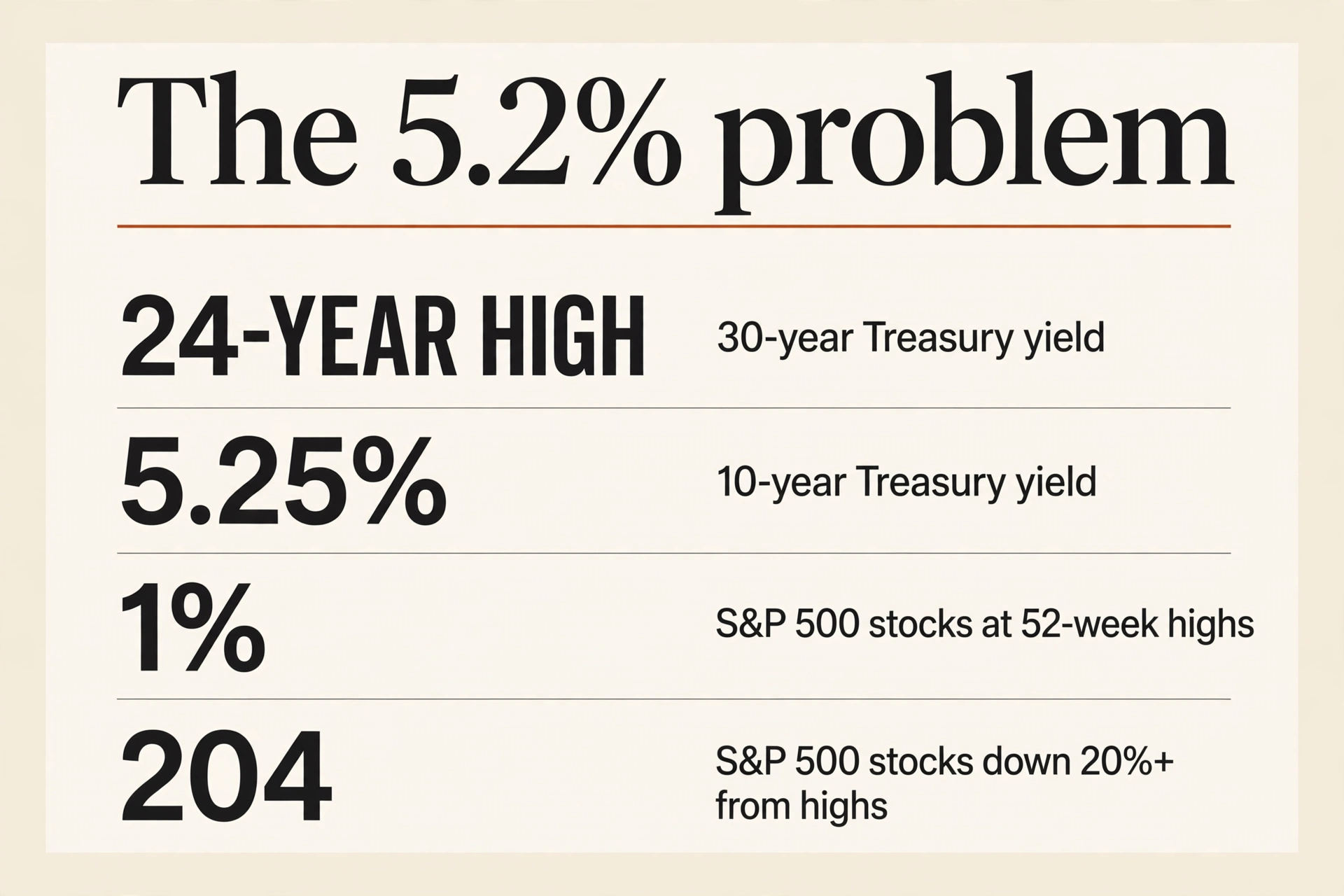
- The tape beneath: 30-year Treasury at its highest in 24 years. Over 50% of S&P 500 stocks trade below their 200-day moving average — the worst breadth since March. More 52-week lows than highs for nine straight days; only 1% of the index at 52-week highs; 204 stocks are down 20%+ from their highs — "over 40% of stocks in the S&P are in a bear market." The Oura IPO was pulled (4x oversubscribed wasn't enough). Dallas Fed: Texas service-sector growth "stalls." Consumer confidence: worse than a dozen years.
- Meta Muse for Small Business (exclusive): a long interview with Dina Powell McCormack, Meta's president and vice chair. Muse is the #1 free app on the App Store; the new Small Business tier automates websites, customer conversations, cash flow, and inventory. Monetization: a fee when Muse helps you save money, plus subscriptions. Meta's pitch: 3.6B people on platform, 200M small businesses. The data-center goodwill case: Richland Parish, Louisiana — Meta's investment generated a tax surplus so large every teacher got a $50,000 bonus. Sixth-generation Delaware peach farmer Henry Bennett says Muse saves him 2–4 hours a week. Kramer's verdict: Muse for small business turns Meta from a cyclical ad company into a "partially secular grower" — "keep buying the stock... I think you can go a lot higher."
- The consumer-inertia thesis: agentic AI like Muse kills "consumer inertia" — the laziness that keeps unused gym memberships (Planet Fitness −18%) and subscriptions alive. Online travel (Booking −10%, Expedia −3%), aggregators (DoorDash, Uber, Lyft), and even banks (Muse hunts for better deposit rates) face pressure. But don't paint with a broad brush: Lifetime's engaged base is safe; Airbnb's selloff is "a steal" — agents book hotels more easily than combing rental listings. He thinks "babies are being thrown out with bathwater."
- Stock calls: American Express (AXP) — "buy more" (down 10% since July; credit fears unproven, growth excellent). Goldman Sachs (GS) — likes it in the mid-800s. Bank callers: Capital One and BNY Mellon ideas both fine.
- BWX Technologies (BWXT) CEO Rex Jevid: the stock is down 27% in three months after a soft quarter, but the investor day laid out a nuclear "super cycle." Backlog doubled from $4B to $8.4B in 32 months; revenue growth 19% year-over-year; 70% of the business is national security (naval propulsion, triad recapitalization, special nuclear materials), 30% commercial — and commercial is the fastest-growing (from $115M to $1.1B in 11 years). "We're betting on the race here, not on the horse." Cramer calls BWXT the only nuclear stock he endorses.
- Lightning round: Farmer Mac (FRMI) — sell ("should never have come public"); HEICO (HEI) — likes the company, hates aerospace right now, oil needs to stay down; QXO — down 40%, but "I can't go against Brad [Jacobs]"; Grab — "stocks do stop at zero."
The day's market callThe market's problem isn't just yields — it's that the AI trade's own leaders are handing ammunition to its critics. Buy the adopters and the infrastructure with order books (BWXT), don't dump whole industries on displacement fears, and watch the bond market: it's "starting to think we got a lot of weaker data coming in."
Tickers: META (Muse for Small Business), PLNT, BKNG, EXPE, DASH, UBER, LYFT, ABNB (steal), AXP (buy more), GS, COF, BK, BWXT (endorsed), FRMI (sell), HEI, QXO, GRAB.
CNBC Fast Money
Skipped — no free caption source (standing rule).