Daily Market Digest · Monday, October 5, 2026
The bond market is screaming. The stock market isn't listening.
Built from tonight's finance podcast transcripts — what the shows actually said, paraphrased, never invented. Sources that weren't available are marked inline.
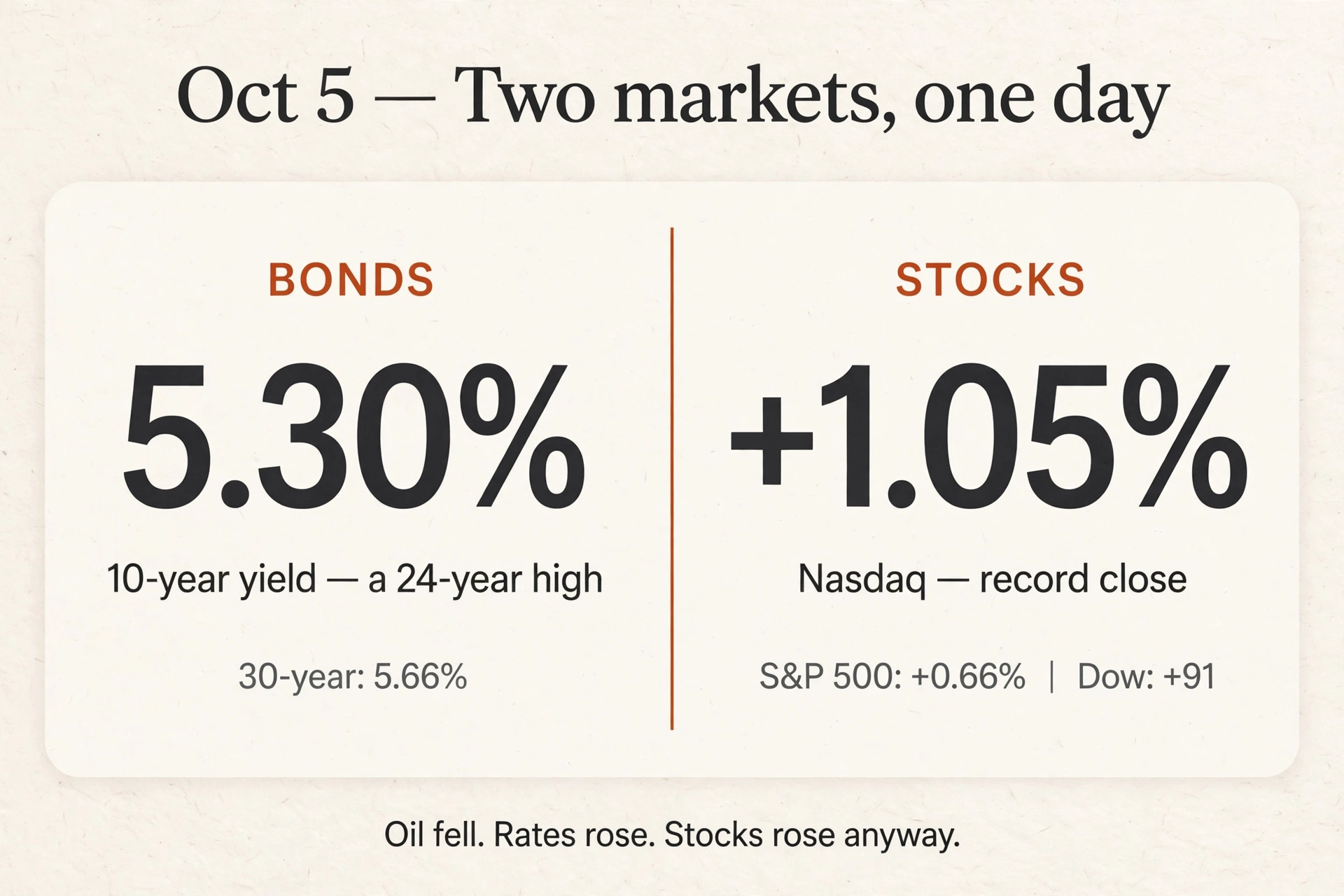
The one thing that matters: the 10-year Treasury yield hit 5.3% — a 24-year high, above even its pre-2008 peak — while the Nasdaq closed at a record and the S&P gained 0.66%. Oil fell, rates rose, and stocks rose anyway: a pattern-break the shows called "bizarre." The day's bottom line, from Cramer and echoed across the tapes: bank on the bond market, not the oil gyrations — bonds, not oil, are telling the truth.
Schwab Market Update
"Oil Falls but Stocks Cool as Yields Stay Warm" — morning edition, Oct 5, 9:11am ET (via search-index cache; schwab.com bot wall as usual)
- At the open: S&P 500 7,722.72 (+0.73%), Dow 51,176.96 (+0.49%), Nasdaq 27,190.86 (+1.19%), 10-year 5.28%, VIX 16.15, gold $4,189.20, WTI crude $90.22 (−0.97%), Bitcoin $86,155.
- Europe agreed to release ~100 million barrels of diesel and Middle East crude exports rose — falling crude arrested early Wall Street losses.
- Treasury yields held near two-decade highs despite Friday's soft U.S. jobs data; stocks edged lower early before recovering.
- This week: PepsiCo (PEP) and Delta (DAL) earnings — both barometers of consumer demand with gas prices soaring; Treasury auctions paint the demand picture.
- Q3 S&P 500 earnings expected to rise 29.5% year over year (FactSet).
- Friday recap: tech-led gains, Nasdaq all-time intraday highs; money flow keeps shifting toward the tech/AI infrastructure complex at the expense of "non-AI" areas that higher rates could hurt (Nathan Peterson, Schwab Center for Financial Research).
The day's market callBreather week between the data blitz and earnings season; watch how Treasury auctions absorb supply with yields this high.
Tickers: PEP, DAL
Bloomberg: The Big Take
"Could High US Bond Yields Spark a Crisis in Europe?" — w/ John Authors (Bloomberg Opinion) and Heather Long (Navy Federal Credit Union chief economist); full transcript via Bloomberg Podcasts YouTube captions
- The 10-year at 5.3% is its highest since 2002 — above the spike that preceded the financial crisis. The 30-year hit 5.66% in the past week.
- The core debate: are yields rising on a stronger economy (the White House's story) or because the market believes taming inflation will take much longer — fiscal plus demographics? Long leans the negative spin.
- France is the flashpoint: the French–German bond spread is the widest since the 2011 sovereign debt crisis. France enters an election year wanting to borrow more than ever, starting from a 5% deficit — "that looks very much as though it could spark the final crisis."
- The UK and Japan are flashing too (Japan's 10-year at 3% after years pinned at zero). Authors: high U.S. yields are the spark; domestic rot is the fuel.
- Authors: expect a "new normal" — don't count on yields significantly below 5% for years. The danger isn't the level, it's the speed of the repricing; credit spreads are oddly calm so far.
- Long's worry line: 10-year past 5.5%. Banks are sitting on government debt yielding well below that (bank stocks had a bad September); 30-year mortgages above 7.5% mean the housing market is "like being in Antarctica — totally frozen."
- Fed Chair Kevin Worsh is "getting better" but needs "forward guidance light"; unlikely to reach Greenspan-level finesse anytime soon.
- On the U.S. consumer: the top 20% are fine, the bottom 25% are struggling, and the middle is quietly cutting groceries and healthcare to keep spending on fun. The Conference Board's current-conditions read dropped sharply — expect a cautious holiday season. 2027, Long says, "is a squeeze."
- ECB playbook: expect ugly brinkmanship, then "whatever it takes" to avoid a French default and euro fracture. A possibly-early Lagarde exit (she's French) could ease the optics.
- U.S. deficit context: preliminary estimates put the 2026 deficit near $2 trillion — versus $1 trillion in the comparable 2019 economy.
The day's market callYields are repricing to a higher-for-years world; watch 5.5% on the 10-year and the French–German spread for the next leg.
Tickers: none directly — rates, France (OATs), ECB
Bloomberg Surveillance
Radio podcast, Oct 5 — guests: Jack Manley (JPMorgan Asset Management), Steven Stanley (Santander), Gen. Jack Keane (Academy Securities); full transcript via auto-captions
- Manley: "Expect more volatility, but also for the winners to keep on winning." Small caps are in trouble, large caps hold up; market leadership is more or less maintained.
- Manley on the Fed: the September hike used cherry-picked indicators and was "much more political in nature" — rates didn't need to move. He still sees the 10-year lower in 12–18 months; ignore the short-term rate noise.
- Global bond contagion from France is a persistent risk; the U.S. edge is energy independence — Europe and Asia can't look through energy-driven inflation the way the U.S. can.
- Stanley: the Fed likely waits in October and hikes once more in December. Worsh has "gone back to his roots" — hawkish again. 2-year around 4.80% this morning.
- Stanley: the labor market is healthy but not overheating — inflation is energy/supply-side, not wage-driven (wage growth at ~5-year lows). Friday's payrolls taught us "not much new."
- Powell is staying on the board but silent — "trying to fade into the background"; the most hawkish voice is now the president's own nominee, Worsh.
- Keane (geopolitics): Saudi-led forces launched a full-scale Yemen offensive against the Houthis; the U.S. rebuffed Saudi requests to join (twice, per Axios) — about 200 personnel for intel/targeting only. No U.S. boots on the ground. U.S. bombers were pulled from the UK over residual Iranian threat reporting.
The day's market callNo October hike, one more in December; winners keep winning while small caps and banks lag — watch labor data, not inflation prints, for the Fed's next move.
Tickers: none directly — Fed, 2Y/10Y, Yemen/Houthis
Mad Money
"Mad Money 10/05/26 | Audio Only" — Jim Cramer; full transcript via YouTube auto-captions
- The bizarre day: Dow +91, S&P +0.66%, Nasdaq +1.05% to a record close — with oil down and rates up. The pattern since February's war (oil up → rates up → banks lose) broke completely.
- Oil: down because the Saudis are discounting ~$5 below the Oman/Dubai benchmark — defending market share, not peace. Hormuz traffic is back to ~80% of pre-war levels. While the war continues, Cramer calls $100 the "pinned price."
- Bonds: the 30-year at 5.66% "feels headed to 6%." Paramount Skydance's $52B of bonds, some trading at 9%, are a red flag, not a bargain. Treasury Secretary Bessent's ~$5B of bond buys were "plugging the dyke with a finger" — and the selloff only accelerated when he admitted it.
- If even a soft payrolls number can't rally bonds for a single day, "the short side is the path of least resistance." Bottom line: "Always bank on the bond market longer term."
- Stocks: the Nasdaq is really three hyperscalers — Nvidia (all-time high), Microsoft (30M+ paid Copilot customers), Meta (Muse winning small business). Strip them out and classic safety stocks got hit, as the bond market says they should.
- HPE deep dive: up ~185% YTD on the AI server boom; Juniper networking deal closed; operating margin doubled to 16.2%; FY27 guide of $4.40–4.60 EPS; under 15× next year's numbers vs Dell at 18× — more upside, though he still prefers Dell.
- Gold: technician Carly Garner sees a high-probability seasonal bounce — gold ~$4,150 with targets of $4,500–4,650. The late-September-to-late-October long-gold trade has worked 12 of the last 15 years; it needs oil to keep cooling.
- Planet Labs (PL) at ~$17, down two-thirds from its $51 May peak: a speculative buy — 58% revenue growth, defense/intel revenue +90%, $850M backlog, an Alphabet stake, and Google AI chips now in orbit on a Planet satellite.
- Microsoft: the "re-institutionalizing of AI" — Melius's "adults are in charge," Azure possibly growing 50%; a 100X survey has Copilot's net future-usage intent (15.3%) leapfrogging Gemini and ChatGPT. Stay in it, even buy it.
- Lightning round: own KLA; Honeywell Aerospace (HON) has "no credibility"; punt on Domino's (DPZ) into the new CEO + earnings; SoFi can bounce; RTX fine; Intuitive Surgical (ISRG) too pricey at 37×; ING and Santander fine; Avery Dennison (AVY) a winner; Ciena (CIEN) good.
The day's market callBonds are telling the truth; the hyperscaler trio is telling the Nasdaq's story. Until yields break, safety stocks stay uninvestable.
Tickers: NVDA, MSFT, META, HPE, DELL, PL, KLA, HON, DPZ, SOFI, RTX, ISRG, ING, SAN, AVY, CIEN
Also checked
- Fidelity Market Sense — no new episode; weekly, drops Tuesdays. Latest (09.29.26, Contrafund's Asher Anolic) was covered Oct 2.
- CNBC Fast Money — no free caption source; skipped per standing rule (never summarize from headlines).