Daily Market Digest · Monday, September 28, 2026
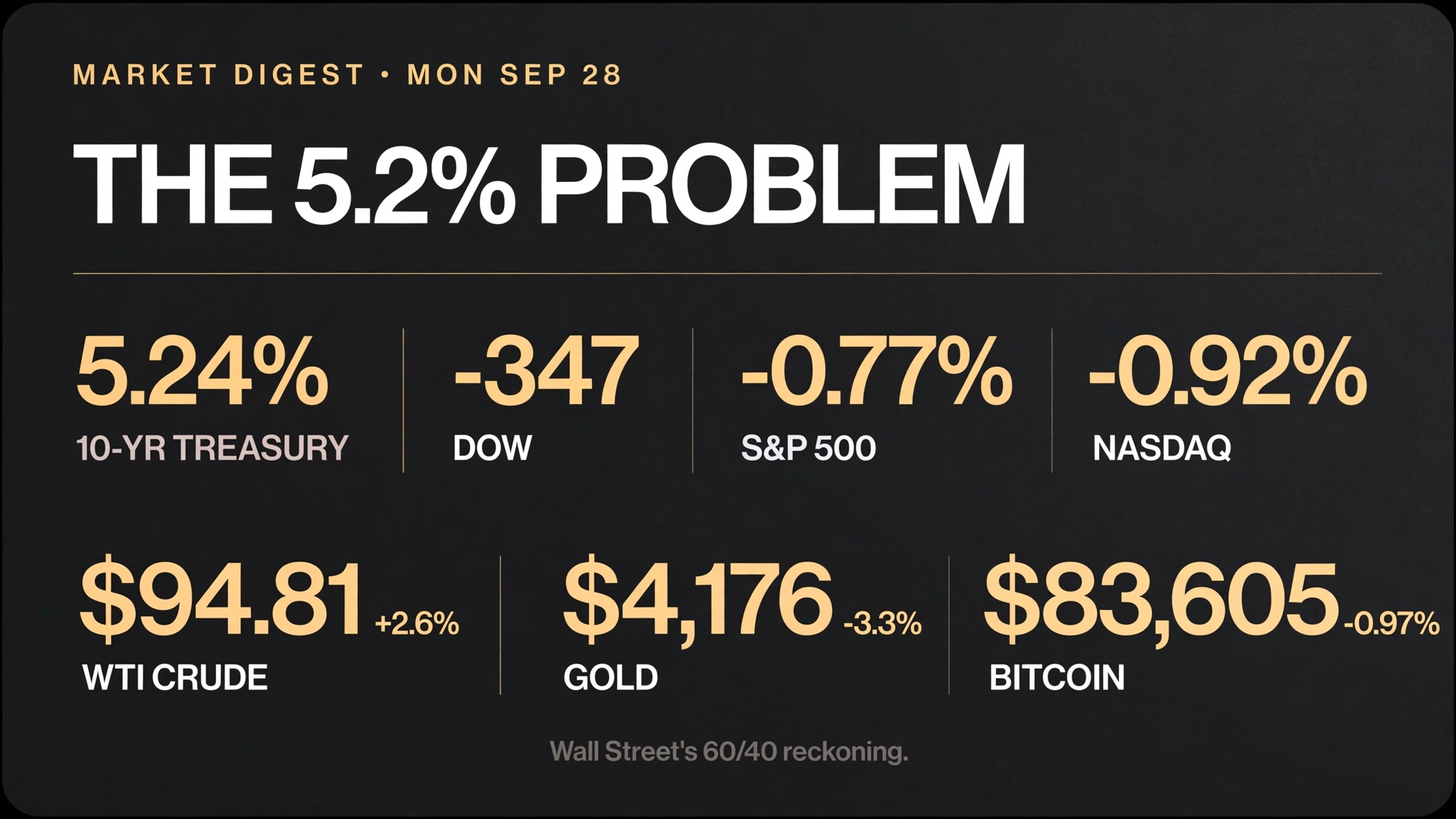
The 5.2% problem: Wall Street debates dumping stocks for bonds.
Built from tonight's finance podcast transcripts — what the shows actually said, paraphrased, never invented. Sources that weren't available are marked inline.
The one thing that matters: the 10-year Treasury is paying north of 5.2% — and Wall Street is openly asking whether the 60/40 portfolio is dead. Wells Fargo research put investor equity allocations at 72%, the highest since 1969, and advisers are telling clients to rotate into bonds. Add the Buffett indicator at a record ~240% of GDP, a 2Y/10Y spread near inversion, and the AI trade's loudest skeptic publicly capitulating. Monday's tape folded under the weight: the Dow dropped 347 points and the S&P slid 0.77% as oil spiked on the Iran-deadline countdown. Tonight's digest is a reallocation episode.
Schwab Market Update
Monday, Sept 28 · Morning edition (9:13 a.m. ET) — "Geopolitics Wrestle with Jobs Data for Attention." Full article text.
- Morning tape: S&P 500 7,743.41 (+0.51%), Dow 51,828.62 (+0.93%), Nasdaq 27,068.72 (+0.48%). 10-year Treasury yield 5.22% (+0.04, near 19-year highs); Dollar Index 101.17; VIX 16.06 (+8%); gold $4,176 (−3.33%); WTI crude $94.81 (+$2.40, +2.59%); Bitcoin $83,605 (−0.97%).
- The week ahead is data-heavy: JOLTS on Tuesday, the August PCE price index (the Fed's preferred gauge) on Wednesday, September ISM Manufacturing on Thursday, and Friday's nonfarm payrolls. It's arguably back to "good is bad" — each robust data point could send yields up and raise October rate-hike odds, already at 64% per the CME FedWatch Tool.
- Iran watch: a media report put U.S.–Iran talks about re-opening the Strait of Hormuz in a "technical" stage; oil exports from the Gulf neared 70% of pre-war daily levels. If progress materializes, the "velocity of the rate rise" could slow or reverse, per Nathan Peterson (SCFR).
- Friday's movers: Akamai popped 3% on a 7-year, $12B cloud infrastructure deal with Anthropic; Bloom Energy climbed ~9% on AI data-center demand hopes; Moderna up 2% (up ~40% in a month on cancer-vaccine excitement); Microsoft surged 3.75% on a Copilot update targeting corporate workers; Meta gave back 3% on profit-taking after its Muse-fueled run.
- Corporate calendar: Micron reports Wednesday after the close, Nike reports Thursday, and Tesla announces Q3 deliveries Friday (consensus 454,000–461,000).
The day's market callThe week begins with geopolitics and ends with data. Small caps "emerged from hibernation" Friday and cyclical sectors showed life — but with yields up 40 bps since the end of August, every data point this week is a yield event.
Tickers: SPX, DJIA, COMP, TNX, DXY, VIX, GC, WTI, BTC. MU, NKE, TSLA this week. AKAM, BE, MRNA, MSFT, META.
Bloomberg The Big Take
Monday, Sept 28 · "Could Bond Yields Break the Stock Market?" Host Sarah Holder with David Papadopoulos and Michael Regan (Bloomberg equities). Full transcript via official YouTube captions.
- The fear/greed pendulum: "swinging between fear and greed every day based on the latest headline" — the question of the episode is whether north-of-5% Treasury yields make stocks unappealing enough to trigger a broad portfolio reallocation.
- Bondholder trauma: the last five years were "brutal" for U.S. bond holders (2022 was "a total wipeout"); anyone who held a 10-year or 30-year through it is still down on price. Investors see 5–5.5% yields but are spooked about timing the jump in.
- The 72% number: Wells Fargo research shows investor equity allocations at 72% — the highest since 1969, versus the classic 60/40 ideal. Strategists are actively advising clients to shift toward bonds.
- Why yields are this high: a hot post-pandemic economy that never cooled + sticky inflation + U.S. deficits around 6% of GDP (unprecedented outside a crisis) forcing a flood of Treasury supply + AI hyperscalers issuing debt to fund the build-out. It's global — Japan, Australia, and Germany yields are all rising too.
- Buffett indicator at a record: U.S. market value is now ~2.4x the size of the economy (~240%), the highest ever — past Buffett's 200% "danger zone." Not a timing indicator, but it means any hiccup "would have a major ripple effect on the Main Street economy." Counter: 2026 S&P earnings growth is expected around 29%.
- The skeptic capitulates: Rajiv Jain — "a big shot in the fund business" and a longtime AI skeptic, heavily underweight AI — just "loaded up on AI stocks" after the pain of underperformance became too great. Emblematic of the tussle: you can believe in a bubble and still be forced to buy.
- Warning signs stacking: the 2Y/10Y spread is the narrowest since early 2025 (inversion risk — "cried wolf before" though), diesel prices at records, mortgage rates above 7%, and wage gains now running below inflation — while consumer confidence sits near all-time lows and the market is up 13–14%. The Main Street/Wall Street disconnect is the episode's closing image.
The day's market callNo verdict that bonds will break stocks — but the reallocation conversation is no longer theoretical; it's happening at every adviser desk. The deciding math is the bond yield after inflation and taxes versus stock earnings growth.
Tickers: none individual. Wells Fargo allocation data, Buffett indicator, AI-infrastructure share (~40% of S&P value per Goldman).
Bloomberg Surveillance
Monday, Sept 28 · TV editions. Full transcript unavailable tonight (caption download hit YouTube's rate limit; no retry per policy). Covered from the official chapter list and guest lineup instead.
- Lineup: Bob Michele (JPMorgan, CIO & Head of GFICC), Lindsey Piegza (Stifel, chief economist), and Henrietta Treyz (Veda Partners) — a rates-and-policy-heavy slate.
- Chapter topics: Trump rejects the Hormuz offer; Clayton Seigle (CSIS) on the war front; Collin Martin (Schwab Center for Financial Research) on fixed income; Nvidia's $150B share buyback authorization; Ajay Rajadhyaksha (Barclays); Amanda Lynam (Goldman Sachs); Tom Becker (BlackRock); Jonathan Golub (Seaport Research); Sarah Kunst (Cleo Capital); Millisa Hutchinson (Nomura); a week of eco data and FedSpeak ahead; a SpaceX launch.
- Asia Trade echo (same night): AMD hit a $1T market cap for the first time; Meta's Muse topped U.S. app charts; U.S.–China trade talks continued in New York (truce extension on the table; truce expires in November); South Korean early exports rose to a record on the chip boom.
The day's market callA rates week in the making: Nvidia's buyback is the corporate confidence counterweight to the bond market's anxiety, while the Hormuz rejection keeps oil in the driver's seat.
Tickers: NVDA (buyback), AMD ($1T), META (Muse app-charts).
Fidelity Market Sense
Weekly — drops Tuesdays. No new episode since Week 212 (2026-09-15); the Week 213 transcript PDF is not posted.
CNBC Mad Money
Monday, Sept 28 · "Mad Money 09/28/26 | Audio Only." Full auto-captions. A red-tape Monday: Dow −347, S&P −0.77%, Nasdaq −0.92% on Iran-deadline uncertainty.
- The "guns and oil" warning: Cramer says the market's drip-torture is uncertainty, not the war itself — if the president would just explain the Iran plan, business could price it. His frame: we're becoming a "guns and oil economy" (a less palatable version of LBJ's guns-and-butter), which historically breeds inflation and forces the Fed tighter.
- Doubling down on Meta and Intel: Meta's Muse is a free personal agentic AI platform that "could potentially have several billion users" — Cramer bets it takes more share than OpenAI. Muse runs on CPUs, and "there are only three major CPU companies: Intel, AMD, and ARM." (Meta's president sits down with him Tuesday.)
- AMD's trillion-dollar moment: the full Lisa Su turnaround story — a $2.5B market cap in 2014 to a near-$1T company, up 18,433% since she took over; September alone up ~30% as the agentic-AI shift exploded CPU demand. "One of the greatest turnarounds in history... arguably the greatest of all time."
- Nvidia's monster buyback: a $150B authorization — "the biggest ever" — and Cramer hopes it's actively managed to buy the dips. Plus an Nvidia engineering plan to "control the run" among autonomous agents, with Anthropic and other big tech on board.
- High-yield stocks are now "dangerous": with the 10-year paying 5.24% "virtually risk-free," dividend stocks "simply can't compete with the bond market." The five highest S&P 500 yielders: VICI Properties (7.93%), General Mills (7.3%), UPS (7%), Edison International (6.8%), Kraft Heinz (6.8%). He walks through dividend cuts as the red flag made real — Campbell's cut 36%, ConAgra halved, Whirlpool suspended. "Safety first? Safety last."
- Costco deep dive: strong quarter, but membership growth keeps slowing (3.8% vs 5.2% → 4.8% → 4.1% across the fiscal year) and younger online members renew at lower rates. At 40x earnings it's a hold, not a buy — price target cut to $1,050 from $1,100. His prescription: a $50 rebate for two warehouse visits to get young members in the door.
- SpaceX bull case: pushes back on "the most overvalued stock on Earth" — Starlink is a real, beloved product; GPU rentals to Google ($11B/yr run rate) and Anthropic ($15B/yr from October); Starship launched today deploying 26 Starlink satellites; and the real long-term prize is humanoid robots (via Tesla). "Not reckless to imagine a much higher stock price... if you have patience."
The day's market callIn a "dark and dawn is not nigh" market, don't abdicate — double down on winners with demand, pricing power, and scale. And with 5.24% risk-free, the era of the high-yield "safety stock" is over.
Tickers: META, INTC, AMD, ARM, NVDA (buyback), CVX, ENB, EPD, VICI, GIS, UPS, EIX, KHC, COST, BROS (Dutch Bros — "raided"), CMG (liked), SMCI (pass), DELL (preferred), FLNC (Fluence — liked), SYM (pass at 100x), PII (Polaris — no).
CNBC Fast Money
Skipped — no free caption source (standing rule).