Daily Market Digest · Tuesday, October 6, 2026
The AI trade is now the entire market.
Built from tonight's finance podcast transcripts — what the shows actually said, paraphrased, never invented. Sources that weren't available are marked inline.
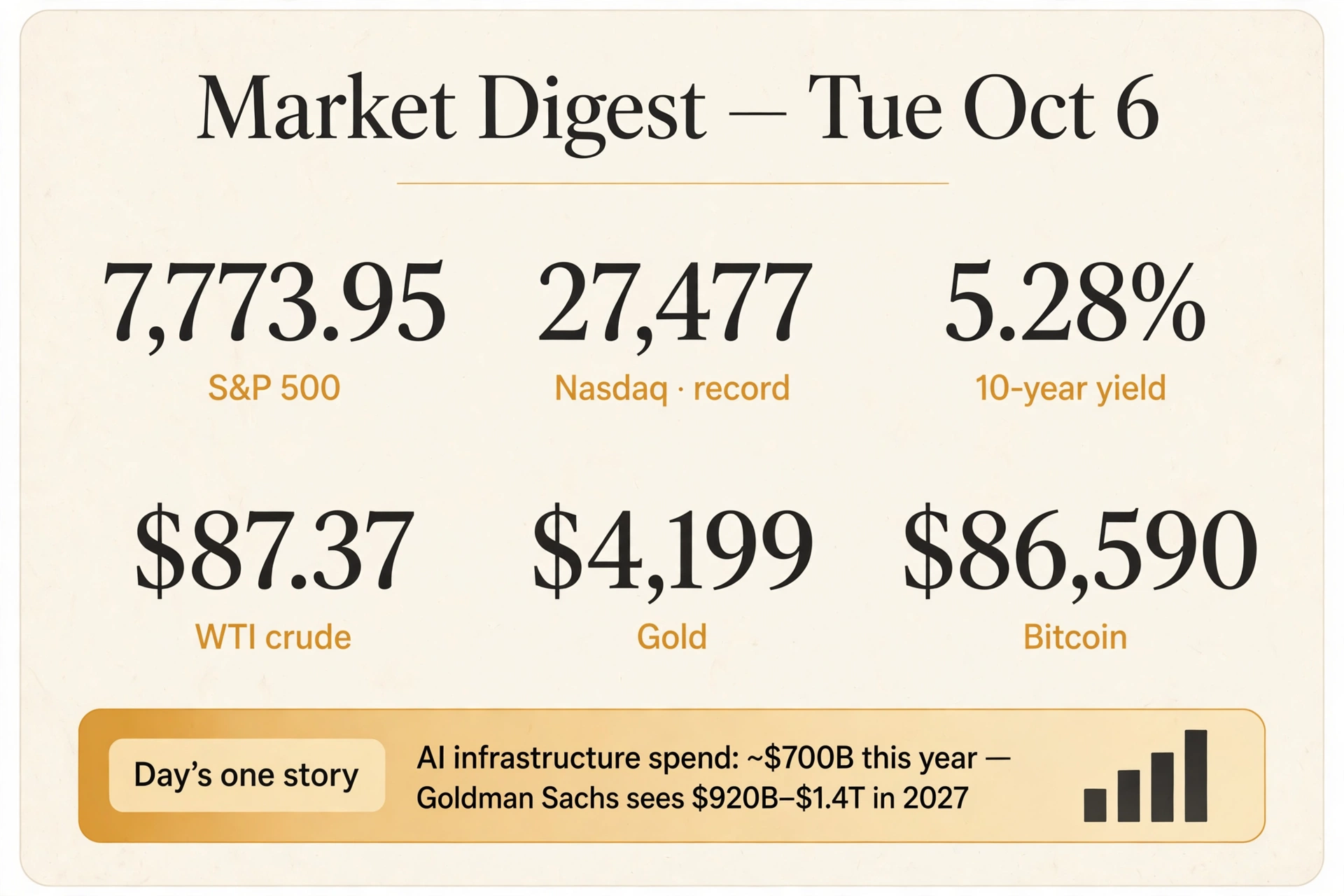
The one thing that matters: the AI buildout is now the whole story. Bloomberg profiled the picks-and-shovels billionaires minted by ~$700B of AI infrastructure spending this year (Goldman Sachs sees $920B–$1.4T in 2027); Cramer declared the market "AI winners versus everything else" and went all-in on "what could possibly go right"; the Nasdaq hit another record. Meanwhile the bond desks — BlackRock and PIMCO — agreed on something striking: yields are the most attractive starting point in decades, with real risk-free rates of 2.4–3.4% now genuine competition for equities, whose dividend yield sits at an all-time low. The tension of the day: records on AI euphoria vs. bonds paying equity-like income.
Schwab Market Update
"Stocks Up on Oil Ahead of Fed Speakers, Auctions" — morning edition, Oct 6, 9:11am ET (via search-index cache; schwab.com bot wall as usual). Audio edition: "Data Flow Slows: Auctions, Yields Take Spotlight."
- At the open: S&P 500 7,773.95 (+0.66%), Dow 51,267.90 (+0.18%), Nasdaq 27,477.31 (+1.05% — fresh all-time highs), 10-year 5.28% (−0.03), VIX 15.32, gold $4,199.20 (+1.03%), WTI crude $87.37 (−2.28%), Bitcoin $86,590. Dollar index at 101.86 — its highest since early 2025.
- Sliding crude (rising Gulf exports + a European diesel release) and a small drop in Treasury yields lifted stocks for a second straight day.
- With earnings and data sparse, attention turns to Treasury auctions — $119B of supply hits the market this week — plus yields and the dollar. Atlanta Fed's GDPNow Q3 estimate: 3.7%.
- Three Fed speakers today, then Wednesday's FOMC minutes.
- AI buildout beneficiaries (materials, industrials) led Monday's rally; mega caps keep performing on strong earnings expectations and a perceived ability to weather higher rates — though heavy hyperscaler borrowing could make even them yield-vulnerable.
The day's market callBreather week between the data blitz and earnings season; the test is whether Treasury auctions absorb this week's $119B in supply with the 10-year near 5.3%.
Tickers: none directly — auctions, yields, dollar
Bloomberg: The Big Take
"The Unexpected Billionaires of the AI Boom" — main + Asia editions, w/ reporter Cindy Wong and Bloomberg Opinion's Katherine Thorbeck; full transcripts via Bloomberg Podcasts YouTube captions
- King Slide (Taiwan): an unassuming Kaohsiung factory making metal server rails for AI data centers — founder briefly became Taiwan's richest person in August; market cap up 3,000%+ in under 4 years to $43B. The AI story has gone "from the software story to one of the biggest physical infrastructure buildouts in the world."
- Wong identified seven companies from Taiwan to China to Switzerland dominating quiet corners of the AI supply chain, minting $62B+ in new shareholder wealth.
- The unglamorous indispensable list: Guangdong DTEK (specialty drill bits for printed circuit boards), Toto (electrostatic chucks for memory-chip manufacturing — yes, the toilet maker), Ajinomoto (insulating materials for advanced chip packaging — yes, the seasonings giant). Decades of manufacturing know-how turned AI-ready overnight.
- Big tech is expected to spend ~$700B on AI infrastructure this year; Goldman Sachs projects $920B–$1.4T in 2027. The constraint is no longer software — it's chips, power, and data-center capacity.
- The risks: 5 of 7 companies sit in greater China — supply chains as geopolitical weapons. And no model maker has found a sustainable path to profit yet; the fastest-expanding suppliers would be hit hardest by a correction.
- King Slide is now trialing production in Texas; you can subsidize a factory, but not "30 years of accumulated manufacturing knowledge."
The day's market callThe AI boom is an infrastructure boom now — and the infrastructure runs through Asia. Watch supplier concentration as much as model progress.
Tickers: NVDA (via hyperscaler capex), King Slide (not US-listed)
Bloomberg Surveillance
Radio podcast "Risk Cycles Across Equities, Bonds, and Currencies" + TV full-day program, Oct 6 — guests: Brian Belski (Humilis), Ozan Tarman (Deutsche Bank), Tiffany Wilding (PIMCO), Stephen Englander (Standard Chartered), Russ Brownback (BlackRock); full transcripts via auto-captions
- Brian Belski (Humilis): we're in a secular bull market with 8–10 years left — and its eventual top won't be AI (think a commodity super cycle / a new emerging market nobody's watching). Higher rates are fine for stocks when earnings are this strong: upward analyst revisions are running at a pace he's never seen in 36 years. Nvidia is about to be the first $6T company. It's a stock-pickers' market — his S&P-beating fund owns neither Meta nor Micron.
- Ozan Tarman (Deutsche Bank, global macro): the French storm has spread into European credit; the ECB won't let it go systemic (expect the TPI tool). Wind is with short euro. Deutsche's US strategist sits at S&P 8,000 and may upgrade; ~27% earnings growth expected this season; consensus trade is "long Brazil, short India." On AI: not the 8th/9th inning yet — "8,200 before 7,400." A split Congress after the midterms would be market-friendly; the risk is a Trump-vs-Fed fight redux.
- Tiffany Wilding (PIMCO): constructive on growth, inflation coming down, central banks will deliver less than priced. Buffers = the AI investment boom + resilient households + the equity wealth effect — but hedge the fragility underneath. Bonds now offer 6–7% in diversified global portfolios — equity-like returns — so rebalance toward bonds.
- Stephen Englander (Standard Chartered): the recent FX move is a euro story (France), not a dollar story. The yen may have peaked — possible end of dollar/yen's decline. The dollar rally is driven by equity/capital flows more than yields. Productivity growth helps the deficit, but far less than in the late '90s: tax revenues come from wages, not corporate profits.
- Russ Brownback (BlackRock, TV): "one of the most attractive starting points in fixed income for decades" — real risk-free yields of 2.4–3.4% are real competition for cash and equities (the S&P dividend yield is at an all-time low). No rate call: the secular-stagnation decade was the abnormal era; nominal GDP of 5–5.5% is normal, and yields belong higher. Own bonds for the income, not a price bounce.
The day's market callThe rate-reset crowd (BlackRock, PIMCO) and the earnings crowd (Belski, Deutsche) agree on one thing: the economy is strong enough to live with these yields.
Tickers: NVDA, META, MU — Fed, ECB/TPI, euro, yen
Mad Money
"Mad Money 10/06/26 | Audio Only" — Jim Cramer; full transcript via YouTube auto-captions
- The frame: three camps on AI — bubble skeptics (dot-com rhyme), secular-growth fundamentalists, and Cramer's own, borrowed from Danny Meyer's book: ask "what could possibly go right?" Meta ($530→$738 on Muse for small business), Microsoft ($350→$529 on Copilot/Azure), AMD, Intel foundries, CrowdStrike and Palo Alto Networks (safety is "the gating factor for growth"). For 80% of the S&P he "can't even think of anything" that could go right — only lower inflation and lower rates.
- Nuclear-power day: Google signed a 20-year contract to buy nuclear power from Constellation Energy (+12%); Vistra and GE Vernova surged alongside. Data centers need electrons.
- Broadcom: finally above where it reported — don't sell; he trimmed but is riding it with the trust.
- CVS deep dive: down 22% to $86 on Caremark/340B PBM trouble — hospitals sued over ~$4B of 340B profits, a CMS proposal would cut Medicare 340B payments from ASP+6% to ASP−33.4%, and an FTC settlement forces conservative pricing. But Aetna and the drugstore business are strong; at <11x this year's earnings and ~10x next year's floor, "too cheap to ignore — too late to sell."
- On Semiconductor: AI data-center revenue more than doubling; the Synaptics deal was renegotiated from $7B in stock to $5.7B in cash — overhang gone. At $86, a laggard-semi catch-up play.
- Grail (GRAL): FDA advisory panel voted favorably Sept 23 for the multi-cancer blood test ($949; $699 online). Stock ran $80→$154, profit-taking to $137. A $6.1B company at 34x sales; Mizuho sees a $15–20B screening TAM, UBS target $175. Start small, build on weakness — speculative after the run.
- On France (historical view): 2012's sovereign-debt crisis became a great buying opportunity; the ECB will step in again; expect scary France headlines "for years to come." "Panic is not a strategy."
The day's market callThe market is AI stocks vs. everything else — and in a 5.28% world, only AI growth doesn't need to borrow.
Tickers: META, MSFT, AMD, INTC, CRWD, PANW, AVGO, MRVL, CEG, VST, GEV, ON, SYNA, CVS, GRAL, EPD
Fidelity Market Sense
Weekly — no new episode
Tuesday check found no new episode: media.fidelity.com 100626 pattern 404s, Fidelity's latest Market Sense is still the 09.29.26 Contrafund episode, already covered on Oct 2. Drops Tuesdays.
Fast Money
Skipped
No free caption source — standing rule; never summarized from headlines.