Daily Market Digest · Friday, October 2, 2026
The jobs miss took October's hike off the table.
Built from tonight's finance podcast transcripts — what the shows actually said, paraphrased, never invented. Sources that weren't available are marked inline.
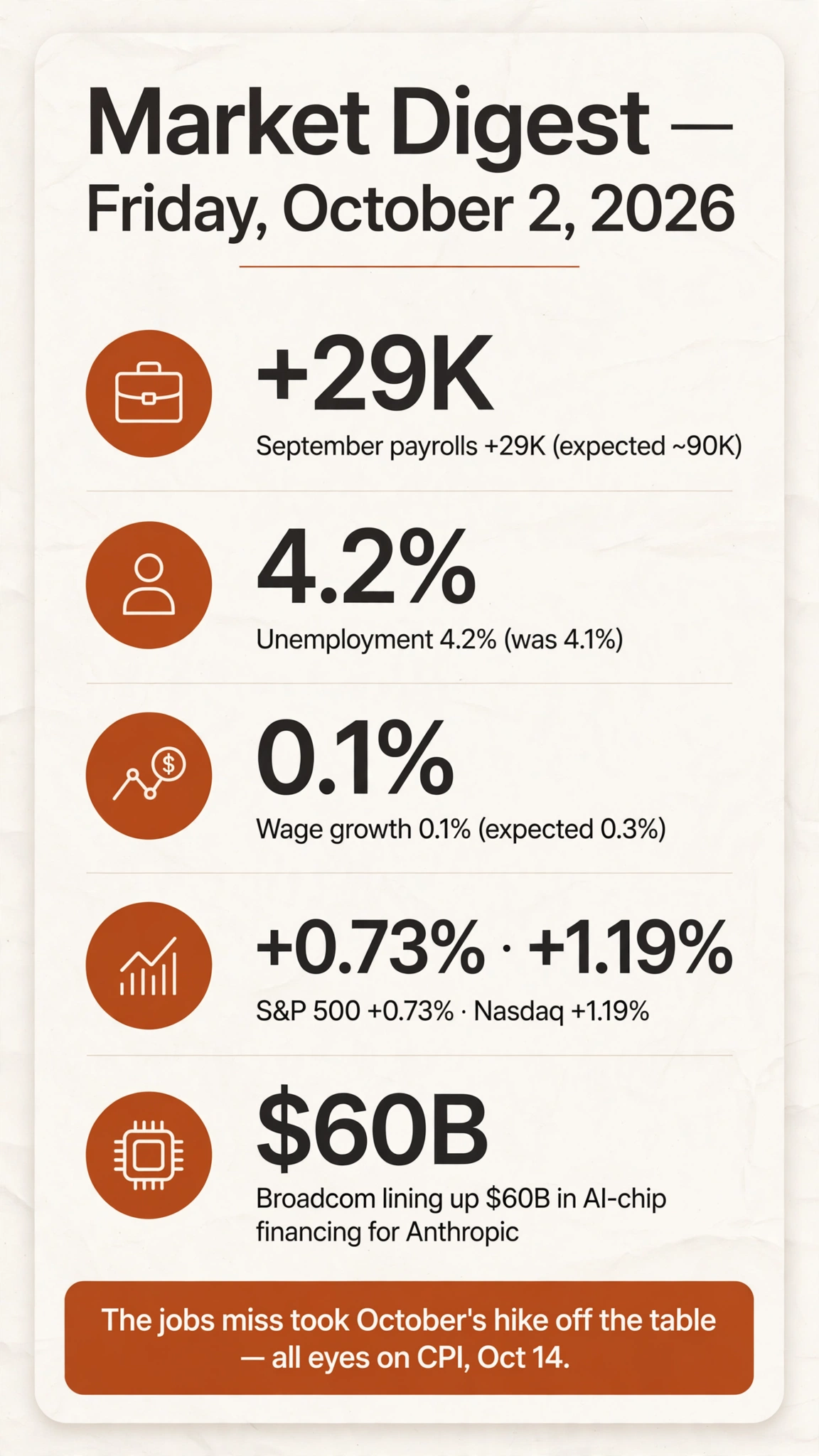
The one thing that matters: September payrolls printed +29,000 against ~90,000 expected, with wage growth of just 0.1% (vs 0.3% expected) and unemployment ticking to 4.2% — the softest labor read in a while. Markets loved it: S&P +0.73%, Nasdaq +1.19%, the 2-year Treasury's biggest two-day rally since March. October's hike is essentially dead — but December is "squarely in the mix," and everyone agrees the next CPI print (Oct 14) is now the whole ballgame. The dissenting note came from Renaissance's Neil Dutta: above-trend growth plus above-target inflation means the Fed stays on its tightening path, and it may take rates meaningfully above ~5% to dent the AI capex boom that's keeping financial conditions loose.
Schwab Market Update
Friday, Oct 2 · "Lower Yields Boost Stocks Early on Soft Jobs Data" (9:13 a.m. ET). Full article text via search-index cache; schwab.com itself remains behind its bot wall.
- The print: jobs growth of 29,000 in September vs consensus of 84,000, with the prior two months revised down by a combined 60,000. Unemployment ticked to 4.2% vs 4.1% expected — but the household survey showed a gain of 406,000 and the participation rate rose.
- Schwab's take: Collin Martin (head of fixed income research, SCFR) called it softness with offsets — "it wasn't all bad." Treasury yields fell on the release, which "takes the pressure off the Fed to hike aggressively."
- Markets at the open: S&P 500 7,666.45 (+0.19%), Dow 50,926.56 (+0.04%), Nasdaq 26,871.59 (+0.04%), 10-year 5.18% (−0.05), VIX 15.59 (−4.88%), gold $4,239.50 (+0.87%), WTI $89.41 (−3.66% on diesel-inventory-release hopes), bitcoin $87,165 (+2.46%).
- The backdrop: Thursday's dovish Fed talk sent short-term yields sharply lower; the tension in the piece is "AI-driven earnings momentum vs rising long-term yields" — chip leaders hold the averages up while high rates weigh on cyclicals.
The day's market callBad news is good news again: soft jobs pulled yields off 24-year highs and took the October hike off the table — but AI momentum and 5%+ long rates are still fighting over who runs the market.
Tickers: none named. Key figures: payrolls +29k (est. 84k), −60k in revisions, unemployment 4.2%, 10-year 5.18%.
Bloomberg Surveillance
Friday, Oct 2 · "Sept. Jobs Report | Bloomberg Surveillance 10/02/2026." Full transcript via official Bloomberg Podcasts YouTube auto-captions. Guests: Seema Shah (Principal), Ed Mills (Raymond James), Michael Gapen (Morgan Stanley), Priya Misra (JPMorgan), Becky Frankiewicz (ManpowerGroup), Neil Dutta (Renaissance Macro), Jeffrey Rosenberg (BlackRock), plus France-bond, credit and FX segments.
- Before the print: dovish Fed speak all week — Jefferson and Williams signaling "no need for urgency" — had already collapsed October hike odds. HY spreads widened 50bps over 8 days; Paramount bonds fell five points in one pop — credit indigestion or something deeper, nobody's sure. Kevin Warsh, per the hosts, may be the hawkish one to watch.
- France's bond crisis deepens: the France–Germany spread has nearly tripled since late February; Germany rallied while France sold off. ECB intervention would be a political nightmare, so the bond market is on its own — and Treasuries are the relative haven (even the US deficit looks better than France's).
- Iran watch: the Pentagon is deploying 10,000 troops and a third carrier to the Persian Gulf; Trump told Time bombing could resume after the midterms. Mills's base case: escalation after the election, in a now-familiar loop — bombing, ceasefire, negotiations, repeat.
- Gapen (Morgan Stanley): low-hire/low-fire is the right frame; AI is already extending unemployment spells in high-exposure occupations. October would need a trifecta — lower unemployment, upside wage surprise, hot CPI (Oct 14). His Fed call: one more hike in December, another in March.
- Shah (Principal): she'd penciled in a "boring" report (65k, 0.3%, 4.1%) — boring is what markets want. The narrative is shifting toward a deeper slowdown; a soft report is good for equities, and yields are close enough to a peak to be adding quality fixed income.
- Misra (JPMorgan): the 10-year's 4.85%→5.30% leg is overdone — technical (negative convexity, futures CTD switch), not data. PCE is tracking to 3% by year-end vs the Fed's 3.4%. Credit 40bps wider is a buying opportunity in high-quality high yield, and duration is getting interesting again.
- Frankiewicz (ManpowerGroup): 72% of employers globally can't find the skills they need; blue-collar wages are outpacing white-collar for the first time in ~20 years of their data. Premium on execution — AI infrastructure, skilled trades — but no broad wage-driven inflation yet.
- The print, dissected: 29k vs 90k; wages 0.1% vs 0.3% (lowest in months); 3-month average stuck at 51k; health care +23k (the winner), temp help −14k (the loser); labor force grew 483k, which is why unemployment rounded up to 4.2%. Schwab's Kevin Gordon flagged the birth-death model taking 190k off the number — maybe softer than it looks.
- Dutta (Renaissance): everything is consistent with 2% inflation except actual inflation. With above-trend growth, the Fed doesn't leave its tightening path without a material data surprise — and it may need rates above ~5% to actually tighten financial conditions, because the AI capex boom doesn't respond to the usual medicine.
- Rosenberg (BlackRock): October is off the table, December is "squarely in the mix," and the Fed will avoid hiking right before the midterms — it would take a big CPI upside surprise. After the fixed-income destruction of recent months, yields are starting to look attractive for portfolio balance.
- AI-debt watch: Broadcom's Wall Street syndicate is gathering $60 billion in fresh AI chip financing for Anthropic and others — adding to the hundreds of billions already raised for the buildout.
The day's market callThe market got the report it wanted — soft, not scary. But nobody on the show thinks the Fed is fighting the labor market; it's fighting inflation. One CPI print, Oct 14, decides whether December lives or dies.
Tickers: AVGO ($60B AI-chip financing for Anthropic), PRM (bonds −5 pts). Key figures: payrolls 29k (est. 90k), wages 0.1%, unemployment 4.2%, 10Y ~5.13%, 2Y −6bp.
Bloomberg The Big Take
Friday, Oct 2 · "The Steamy, Billion-Dollar World of Romantasy" (host David Gura with Hannah Miller and Madison Muller). No market-relevant episode today — this week's Friday feature is a culture/business episode on the near-billion-dollar romantasy publishing boom, not markets. No market summary from this show tonight.
Fidelity Market Sense
New episode: 09.29.26 — "Investing Ideas From One Of The World's Largest Funds." Contrafund co-manager Asher Anolic on how he helps run the $170 billion large-cap growth portfolio. Description-level only — no free transcript (fidelity.com pages are JS-walled, YouTube captions absent, media.fidelity.com PDF pattern 404).
- The pitch: Contrafund's philosophy — searching for innovative companies, evaluating emerging trends, finding opportunities others overlook; plus learnings from longtime manager Will Danoff.
- Themes on the agenda: thoughts on the AI boom, the space economy (and the risks of space stocks), post-Covid investment trends, housing & remodeling opportunities, and how to invest in a bull market.
The day's market callFrom the chapter list alone: Fidelity's biggest fund is thinking AI, space, housing — the same capex-and-consumption story everyone else is pricing. Details locked behind the paywall-free transcript that doesn't exist.
Tickers: none named in the description. Hashtags hint: SpaceX, AI stocks, health-care stocks.
CNBC Mad Money
Friday, Oct 2 · "Mad Money 10/02/26 | Audio Only" (CNBC Television). Full transcript via YouTube auto-captions.
- Friday's relief rally: the soft jobs report did the bulls' work — Dow +250, S&P +0.73%, Nasdaq +1.19% — though the rally faded as rates bounced back off their morning lows.
- Oil deal: the US plus the rest of the G7 agreed to release 100 million barrels of emergency oil and diesel from strategic reserves over four months. Cramer wants crude in the 80s before trusting a rally's staying power — diesel scarcity is "a very difficult situation for truckers."
- Next week's game plan: Tue — NY Fed's John Williams speaks (dovish encore, please); Tue — Marvell (MRVL) analyst day, Matt Murphy on the data-center buildout; Tue after close — Constellation Brands (STZ), down 19% YTD, as alcohol "ages out" (GLP-1s, younger drinkers skipping beer). Wed — Levi's (LEVI, under $20 from $25 in July). Thu — PepsiCo (PEP): down 12%, 4.7% yield can't compete with a 5.28% 10-year, and he's firmly Team Coca-Cola (+22.5% YTD). Fri — Delta (DAL) plus Michigan sentiment into the midterms.
- Nike, the full autopsy: 13-year low after a disappointing print. Three severe problems — Greater China revenue down an "astounding" 26%, sportswear down low-double-digits, and the Jordan brand in trouble from retro over-supply. The new CFO had to publicly defend the dividend ("once it's on the table, it never leaves"). Cramer won't buy it, but CEO Elliott Hill gets sympathy: he "got dealt a very tough hand" — a "definitive underdog."
- AI-brand data (100X CEO Rob Pace): Claude is the #1 brand of 6,000 tracked for "going to use AI more"; reliability is the industry's Achilles heel — 1 in 5 users flag it, up from 1 in 6. Application-layer AI is mostly ignored, and when noticed, skews negative. It "won't disrupt software or consulting overnight."
- Corteva's spin-off: Vor (VOR), the seeds business, gets a buy with an $85 price target (Frank Mitch) — the "innovative" half. Remaining Corteva is crop protection: a "show me" story.
- Lightning round: Planet Labs (PL) — buy, "terrific company"; Duke Energy (DUK) — 4% yield utility; Quanta (PWR) — liked for the buildout.
- The warning: earnings season is nearly here, and with the Fed determined on inflation, "it's certainly a lot harder than it used to be" to make money in stocks.
The day's market callSoft jobs bought the bulls time, but Cramer says the week ahead is quiet — and earnings will be the first exam of whether 5%+ rates let anyone keep their multiple.
Tickers: MRVL, STZ, LEVI, PEP, KO, DAL, NKE, VOR, CTVA, PL, DUK, PWR, SLB, MSFT, SPCE.
CNBC Fast Money
Skipped — no free caption source for tonight's episode (standing rule: never summarize from headlines).