Daily Market Digest · Monday, October 12, 2026
The AI money loop is starting to look like 2008.
Built from tonight's finance podcast transcripts — what the shows actually said, paraphrased, never invented. Sources that weren't available are marked inline.
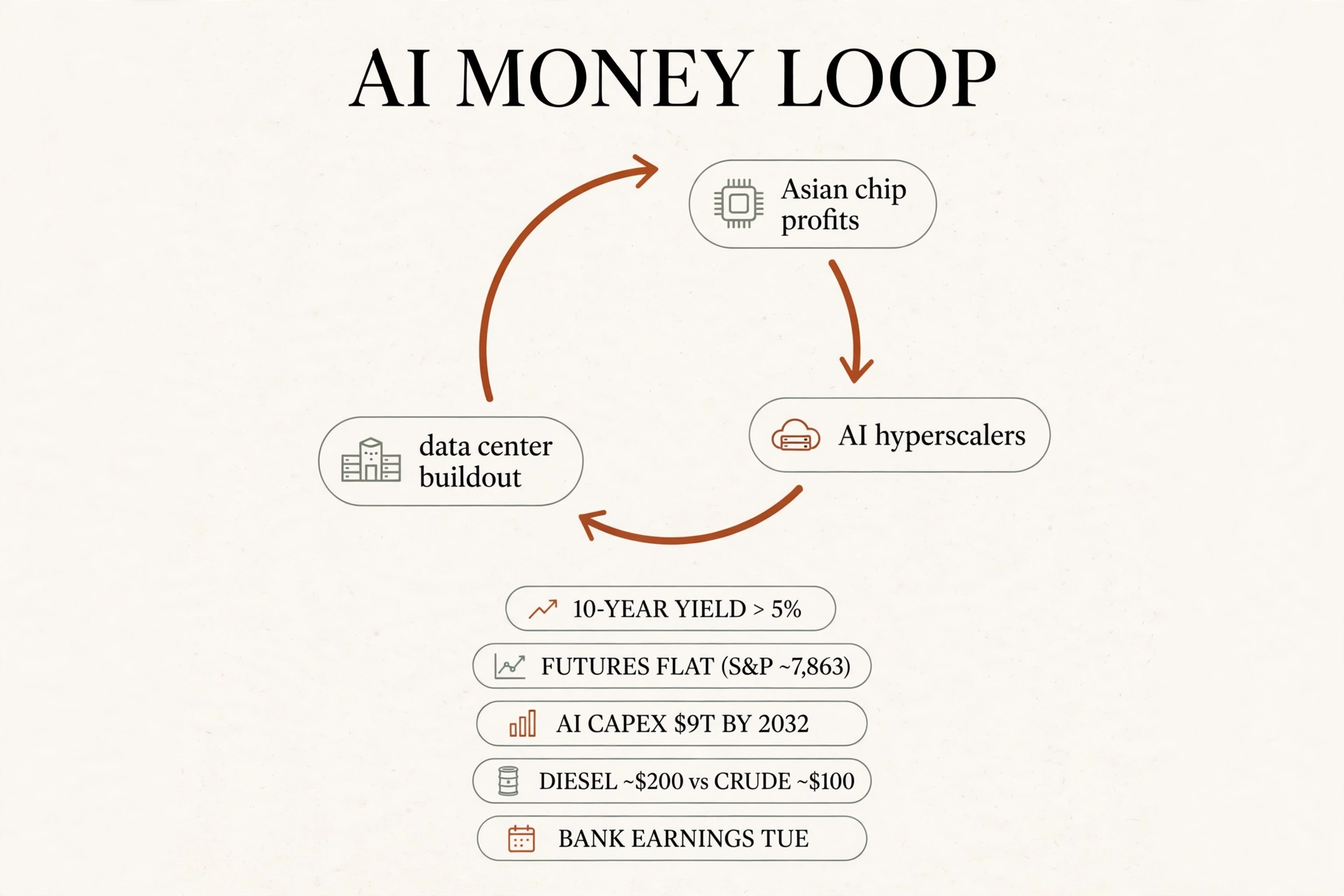
The one thing that matters: the circular money flow powering the AI boom — chipmakers investing in the same AI labs that buy their chips, Asian tech savings flowing straight back into the hyperscalers — has pushed global imbalances to 150-year highs, back near 2008 levels. Bloomberg Economics' Tom Orlik flagged the critical difference: this time the savers aren't cautious central banks, they're return-chasing private investors, and the "safe asset" isn't Treasuries — it's AI hyperscaler equity. If the AI payoff arrives too slowly, Asia's "techno-states" (Korea, Taiwan) get hit twice: as exporters and as investors. Everywhere you looked today, the market was asking the same question: how long can yields keep climbing before something breaks?
Schwab Market Update
"Earnings Season, Inflation Data In-Focus This Week" — Market Update Podcast, Oct 12 (description via schwabassetmanagement.com; the written morning article wasn't published today — Columbus Day holiday, bond market closed; schwab.com bot wall as usual)
- Major banks kick off third-quarter earnings season this week as markets grapple with elevated Treasury yields, energy supply disruptions, and ongoing geopolitical tensions.
- Week-ahead calendar: Tuesday brings JPMorgan (JPM), Goldman Sachs (GS), Wells Fargo (WFC), Citigroup (C), UnitedHealth (UNH), J&J (JNJ), Domino's (DPZ) plus September existing home sales; Wednesday is September CPI + the Fed Beige Book with ASML, BofA, Morgan Stanley, BlackRock; Thursday is TSMC, PPI, jobless claims.
- Context from Friday's edition: FactSet expects S&P 500 Q3 earnings to grow 29.5% — a third straight quarter above 25% — with energy (+114%) and IT (+65%) leading; 72 companies issued positive guidance, the highest since FactSet began tracking in 2006.
The day's market callQuiet open (futures flat) ahead of an event-stacked week: bank earnings Tuesday, CPI Wednesday, TSMC Thursday.
Tickers: JPM, GS, WFC, C, UNH, JNJ, DPZ, ASML, BAC, MS, BLK, TSM, SPX
Bloomberg: The Big Take
"AI's Giant Money Loop Is Feeling Very 2008" — host David Gura with Bloomberg's Shawn Donnan and Bloomberg Economics' Tom Orlik; Oct 12, full transcript via auto-captions
- The circular loop, two layers deep: a chipmaker invests in an AI lab, which buys chips from that same chipmaker — and at the macro level, US demand for AI chips sends dollars to South Korea and Taiwan, whose savings pools flow right back into US equities, bonds, and the very AI companies buying the chips.
- Global imbalances are back near their highest in 150 years — roughly where they were in the early 2000s before 2008. Historically these often precede crises. Former IMF chief economist Pierre-Olivier Gourinchas called it "the global economy working as it should" — but warned even sensible episodes aren't a blank check.
- The actors changed, and that's the risk: pre-2008 it was cautious central banks buying safe US Treasuries; now it's nimble private investors buying AI hyperscaler risk. AI is also a "huge sucking sound" competing with Treasuries for capital — which is why, unlike the 2000s, the capital inflow is raising US yields instead of lowering them. The 10-year sits above 5%; annual US interest costs now exceed $1 trillion.
- The "techno-state" double blow: Korea and Taiwan look like resource-dependent economies exposed to Dutch disease — if the AI boom turns, they get hit both as exporters of AI inputs and as investors in the boom.
- Scale of the boom: a Brookings/NBER paper estimates $9 trillion will go into the AI buildout from 2025–2032 — about 3.2% of GDP a year, the biggest capital investment boom in US history, bigger than the 1890s railways. History's lesson: these episodes can be great in the long run and still come with a downturn in the middle.
- Bubble warning signs accumulating: a pulled Australian data-center IPO (investors balked at the valuation), questions over OpenAI's revenue run-rate. As Howard Marks reminded the show: you can't call a bubble until it pops.
The day's market callAI is funding the global economy and feeding the global economy — the loop accelerates the buildout if AI delivers, and amplifies the damage if it doesn't.
Tickers: TSM, Samsung (005930.KS), NVDA, MSFT, AMZN, GOOGL, META, ORCL, CRWV
Bloomberg Surveillance
"Upward Pressure on Yields and Equities" (radio, Keene & Sweeney) + "Bloomberg Surveillance TV: October 12th, 2026" (TV, Ferro/Abramowicz/Hordern); Oct 12, full transcripts via auto-captions
- Matt King (Satori Insights) on why nothing has broken — yet: rising yields aren't just about growth; they're about who's borrowing and their relentless desire to borrow. US deficits have been quietly self-financed via money-market funds, hedge funds, and repo — a mechanism that's now coming under pressure. Repo outstandings have roughly doubled since 2020 to $7 trillion: "reminiscent of 2008 — not the immediate magnitude, but risks pushed into the tails." Day-to-day volatility stays low while tail risks rise.
- Ken Leon (CFRA) previews bank earnings: bank stocks have pulled back and valuations look more reasonable than at the mid-August peak; he sees opportunities in capital markets and investment banking. Credit quality is in a "neutral zone" — no significant loan-loss increases expected for Q3 — but deposit competition is real, and agentic AI could let consumers move deposits faster, a structural challenge to the bank funding model.
- Larry McDonald (The Bear Traps Report) on credit stress: the proliferation of serial convertible bond issuers among the neoclouds (CoreWeave) is his classic tell that high-yield markets are shutting them off — "it's happening right now." Meanwhile, the market's internals have already crashed: ~40–50 world-class brands (Nike, Lululemon, Harley-Davidson, McDonald's, Home Depot) are down 30–70%, even as the index holds — "they're pinning the index." And in three years, SpaceX + Anthropic + OpenAI went from $360B to $5.1 trillion — one-time markup events now distorting S&P earnings.
- Fed watch: Wednesday's CPI is expected at 0.6% month-over-month — "a crazy number." McDonald hears the Fed is "playing tough" behind the scenes and more worried about credit than it admits.
- Selma Hepp (Cotality) on housing: the 30-year mortgage is 7.51%; home sales sit near multi-decade lows adjusted for population; average price cuts are 3–5% (normal). The psychological unlock is a rate at or below 6% — Florida and Texas demand revived when rates touched six. At 8%, more markets start to deteriorate. Average homeowner equity is ~$310K but only ~2% has been tapped via HELOCs.
- Amrita Sen (Energy Aspects) on diesel: the real energy pain isn't crude (~$100) — it's diesel near $200, driven by a lack of refining capacity (Ukrainian strikes on Russian refineries plus offline Middle East capacity). Trump's Russia "energy ceasefire" isn't real — both sides seem unaware of it — and the extra Russian barrels announced make no difference. No diesel relief in the next four weeks.
- Torsten Slok (Apollo) on the Fed's trap: high rates choke construction → supply falls → rents rise → inflation stays high — a perverse feedback loop, with owner's equivalent rent ~25% of CPI. Roughly half of US GDP growth is currently AI-driven; if rate-sensitive sectors and AI both slow in 2027, the three hikes markets are pricing won't happen.
The day's market callBond-market stress is the main event — yields grinding higher on supply and AI competition for capital, credit cracks showing at the neocloud fringe, and Wednesday's CPI decides whether the hawkish Fed repricing continues.
Tickers: JPM, GS, MS, CRWV, NKE, LULU, HOG, MCD, HD, META, NVDA, ORCL, MSFT, SBUX, CMG, TSLA, SPX, Treasuries, diesel/WTI
Mad Money
"Mad Money 10/12/26 | Audio Only" — Jim Cramer; full transcript via YouTube auto-captions
- 4th birthday of the bull market: the rally born Oct 12, 2022 — born in extreme pessimism after a 6.6% core CPI print — has lifted the S&P 118%; $10,000 then is $23,600 now. It survived the SVB banking crisis, the fastest rate hikes in decades, the April 2025 tariff shock, and the Iran war. Cramer's lesson: "There never seems to be a good time to invest... consistent investing, putting money to work regularly in good and bad times, is by far the best strategy."
- Mary Barra (GM) interview: auto stocks are struggling under rising rates and high oil, but GM is selling "everything we can make" — full-size trucks up 9% in Q3, new Silverado/Sierra launching this month; EV growth will be slower but continues (next-gen LMR batteries will cut thousands per vehicle); 37% of shares bought back since she took over; GM Defense growing with a Lockheed partnership; personal autonomy targeting "eyes off, hands off" by 2028.
- Homework: Argan (AGX) — the power-plant builder (78% of sales) is a data-center electricity play with a blowout quarter (62% revenue growth, $1.03B cash, zero debt, dividend raised 40%) — but the backlog shrank from $2.93B to $2.52B with no major new power awards, and the stock trades at ~25x next year's earnings. Verdict: endorse holding long-term, but don't chase it — wait for a better entry.
- The software-vs-hardware seesaw: since the leveraged "Situational Awareness" hedge fund imploded in July (long hardware, short software, allegedly down 67%), enterprise software has roared back — the IGV software index is up 23% since end of June while the SMH semiconductor index is down 10%. Salesforce caught a double upgrade today on bookings. Cramer: software is king again, but "both are more like knights or bishops" — too hard to call either bottom or top.
- Lightning round: likes Nokia (AI fiber at the edge), AADX (stick with it), BlackBerry (good story); passes on Mondelēz, AMRC, and Ambarella in a rising-rate environment.
The day's market callStay invested — the 4-year-old bull survived everything; rotate carefully between software's comeback and hardware's slump, and demand new contracts before chasing data-center construction names.
Tickers: GM, AGX, NOK, AADX, BB, AMRC, AMBA, CRM, NOW, MSFT, IGV, SMH, SNDK, MU, WDC, INTC, AMD, NVDA, DELL, HPE
Fidelity Market Sense
No new episode
Latest episode ("How has the market performed during midterm elections?", Oct 6) was covered in the Oct 7 edition. Fidelity drops Tuesdays; nothing new since.
Fast Money
Skipped
No free caption source — standing rule; never summarized from headlines.