Daily Market Digest · Friday, October 9, 2026
The "AI slowdown" was a rounding error.
Built from tonight's finance podcast transcripts — what the shows actually said, paraphrased, never invented. Sources that weren't available are marked inline.
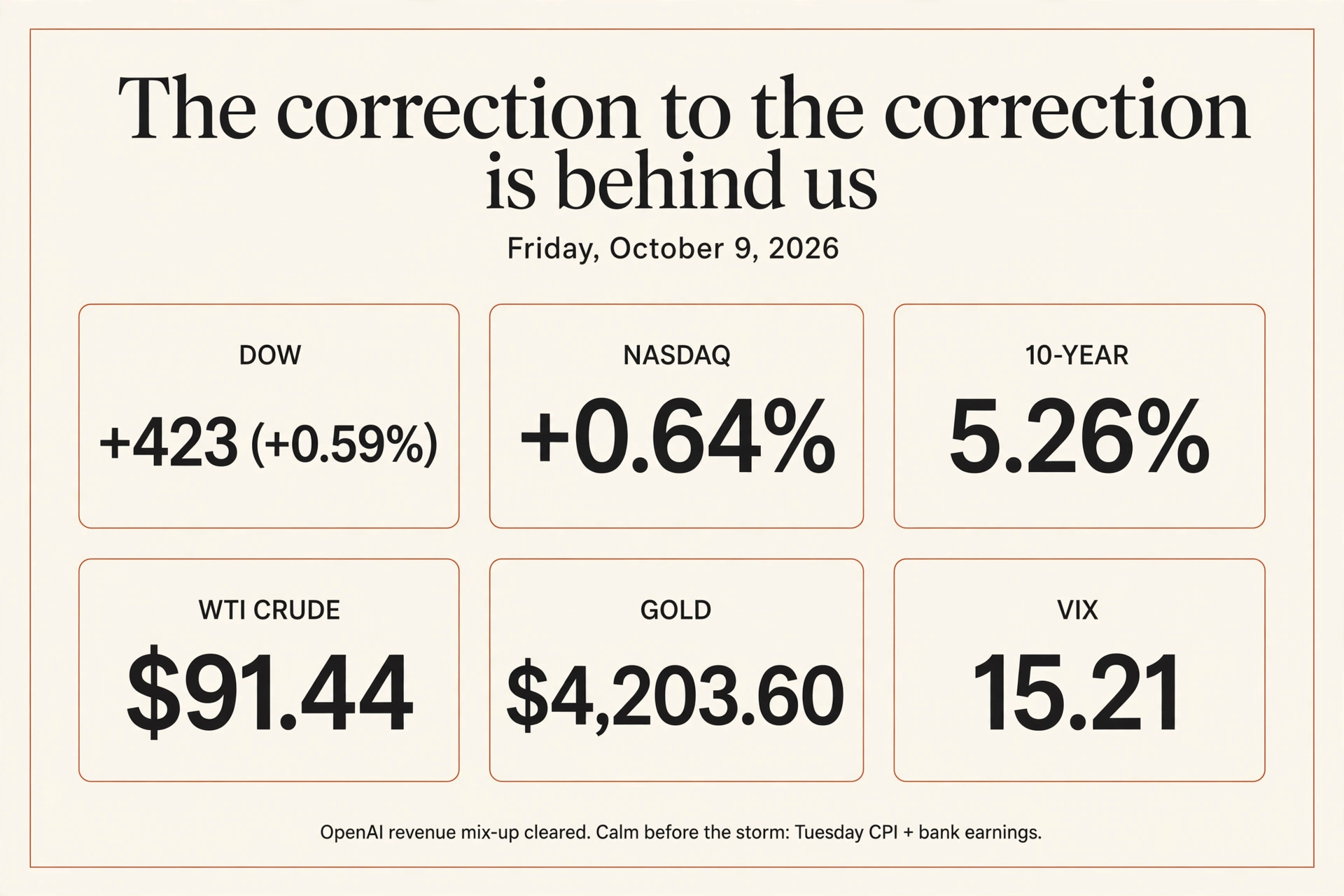
The one thing that matters: the OpenAI "$20B revenue miss" that torched Thursday's tape was an accounting mix-up, not deterioration — $70B was gross revenue, $50B was net, and "ARR" was misused. Nothing at OpenAI actually got worse, so stocks and bonds both rallied Friday. But the relief sits on shaky ground: the Fed is getting more hawkish (Musalem floated more hikes, Waller wants front-loaded tightening, a December hike is back in play), the 30-year is grinding toward 6% vigilante territory, and Tuesday's CPI plus big-bank earnings is the next decider. Today's consensus: "calm before the storm."
Schwab Market Update
"Stocks Rebound Early as AI Jitters Ease" — morning edition, Oct 9, 9:10am ET (via educationcontent.schwab.com; schwab.com bot wall as usual)
- Tech led stocks higher early Friday as anxiety over OpenAI's revenue faded and oil prices stabilized — a rebound after Thursday's rout.
- Thursday's recap: Nasdaq fell 1.3%, its worst day since mid-August, after OpenAI revenue came under scrutiny, hitting AI stocks; S&P 500 fell 0.6%, but six of 11 sectors closed higher with energy up nearly 3% on an oil surge.
- Thursday-close markets table: S&P 500 7,765.36 (−0.47%), Dow 51,231.64 (+0.10%), Nasdaq 27,193.34 (−1.25%), 10-year Treasury yield 5.26%, dollar index 102.31 (+0.17%), VIX 15.21 (−1.30%), gold $4,203.60 (+1.12%), WTI crude $91.44 (−0.05%), Bitcoin $83,068 (+1.69%).
- The economic calendar is light: investors watch today's University of Michigan preliminary consumer sentiment report, and KC Fed President Jeffrey Schmidt speaks at the Kansas City Economic Outlook.
- Context from the options-update page: Thursday's selloff also tied to Middle East escalation pushing oil ~5% higher, plus Fed Governor Christopher Waller's line that multiple rate increases might be needed to tame inflation.
The day's market callEarly rebound led by tech as OpenAI-revenue jitters ease and oil stabilizes; watch Michigan sentiment and Schmidt's remarks.
Tickers: SPX, DJI, NDX, TNX, DXY, VIX, WTI, GLD, BTC
Bloomberg: The Big Take
"Inside the Enigmatic Firm That Rules Wall Street" — host David Gura with Bloomberg finance reporters Max Abelson and Katherine Doherty; Oct 9, full transcript via auto-captions
- Jane Street, the secretive NYC trading firm with 3,000+ employees, pulled in ~$40B in trading revenue in 2025 — out-earning JPMorgan, Goldman Sachs, and Citadel on pure trading, with far fewer people, thanks to heavy automation. It doubled compensation to $9.38B in 2025.
- Three revenue engines: millisecond market-making (earning the spread on every trade), longer-duration principal trading (holding positions minutes to weeks), and private-company investing — highly unusual for a market maker.
- There is no CEO or chairman, just a management committee; execs hide behind initials on LinkedIn; Bloomberg's reporters cracked the org chart via regulatory filings. Staff skew math-Olympian types, with effective altruism woven through and political donors on both sides.
- Sam Bankman-Fried interned and worked there — his infamous "heads, the world gets 2x better; tails, total annihilation" coin-flip ethos is presented as emblematic of the firm's risk culture.
- Jane Street is core market plumbing: if you own an ETF, it very likely touched it. More recently it's taken bigger principal swings into AI — stakes in Anthropic and CoreWeave, and its own trading data center.
- First reported loss in roughly a decade: a $15B hit in July tied to the AI hedge fund "Situational Awareness"; internally a leader sent a memo saying the firm would recalibrate risk-taking, but nothing was disclosed publicly.
- Why it matters: the firm sits at the center of global markets with zero public accountability — if something breaks, there's no clear "where the buck stops." The episode frames it as financialization's next phase: profits now made in Texas data centers and New Jersey fiber, not dealing rooms.
The day's market callNo market call — a profile piece, not a trading-day story.
Tickers: GS, JPM, CRWV (Anthropic is private)
Bloomberg Surveillance (TV)
"Bloomberg Surveillance 10/9/2026" — full-day TV program, Oct 9; full transcript via auto-captions
- Equities bounced after Thursday's tech rout: the OpenAI $50B-vs-$70B revenue confusion was clarified (Bloomberg reporting OpenAI expects to exceed $70B annualized); Friday futures ran up ~0.8%.
- Bonds caught a big relief bid: the largest one-day drop in 10- and 30-year yields since ~Sept 17, driven by two of the strongest Treasury auctions on record; yields ticked ~2bp back up Friday morning. Open question: is the Treasury regaining true safe-haven status after months of trading "like a meme stock"?
- Oil/geopolitics: Trump said no Iran strikes before the Nov 3 midterms, easing crude (Brent ~$103) — but the calm looks fragile: 3 Saudi citizens killed in airport attacks, the US embassy in Jordan told Americans to be ready to relocate, and March/Dec 2027 oil forwards sit at all-time highs.
- The Fed is getting more hawkish, not less: Musalem floated additional hikes, Waller wants front-loaded tightening, and Macquarie's Weisman said it's "difficult for the FOMC to avoid hiking in December if they skip October." 6%+ on the 30-year is bond-vigilante territory.
- AI capex is "incredibly durable" (Barrett's Veron): focus is shifting from picks-and-shovels semis toward who monetizes AI and captures productivity gains; Citi Wealth's line: "AI is broadening, not ending."
- Earnings kickoff: PepsiCo fell ~6% post-Q3 on margin compression and share questions; Delta cut its full-year EPS guide ~24% on a ~$6B fuel headwind — but premium demand +18%, main cabin +12%, loyalty revenue +18%, and Jefferies keeps a Buy on DAL with street targets $82–$114.
- Consumers still spending: BofA Institute showed strength across all income cohorts with lower/middle-income recovery continuing; with nominal GDP at 6%+, no significant default cycle is expected.
The day's market call"Calm before the storm" — relief rally in stocks and bonds, but geopolitical risk and hawkish Fed repricing leave the market leaning cautious into Tuesday's CPI and big-bank earnings.
Tickers: DAL, UAL, AAL, PEP, JPM, GS, BAC, MS, C, WFC, NVDA, oil/Brent, Treasuries
Mad Money
"Mad Money 10/09/26 | Audio Only" — Jim Cramer; full transcript via YouTube auto-captions
- Market day: Dow +423 (+0.59%), Nasdaq +0.64% — a rebound after "a jarring day of mistaken assumptions about an AI slowdown." Cramer's verdict: "the correction to the correction is now behind us."
- The OpenAI $20B "revenue miss" was an accounting mix-up, not deterioration: $70B was gross revenue (reported the way Anthropic reports), $50B was net; journalists also misused "ARR" (run-rate vs. recurring). Nothing actually got worse for OpenAI or the AI complex — but the selloff shows how dangerously the market trades on hearsay about private-company numbers ahead of Anthropic's IPO.
- Stop calling it the "AI trade" — it's the AI industry, "the new oil": when Zuckerberg, Musk, and Nadella commit hundreds of billions, that's investment, not a trade about to unwind. A poorly structured Australian data-center IPO and one FT headline don't end an industry.
- Earnings game plan for the truncated week: Tuesday bank earnings — GS (beaten down $1,153→$895), WFC (cheap at ~10x next year, improving net interest margin), JPM (priced for perfection), Citi (Fraser turnaround regroup test), plus UNH (beat-and-raise setup) and JNJ ("a terrible trader" — buy the post-print dip). Wednesday: CPI + ASML (buy LRCX/AMAT on a raise). Thursday: TSMC (the number that "could control pretty much any chip stock"), retail sales, Schwab analyst meeting.
- Delta: loves the premium/loyalty story (>$9B/year from the Amex partnership, corporate sales strong), holds off buying into the fuel spike but sees the airline "printing money" once crude normalizes; Bastian refused to engage Musk's swipe over the LEO-vs-Starlink Wi-Fi pick.
- "Am I Diversified?" segment: portfolios are drowning in correlated tech — one caller told to swap MRVL for JNJ, another to trade MSFT→RTX and CSCO→WFC.
- Bonds color everything: with the 30-year grinding toward 6%, "too much supply, not enough demand" in bonds — stay long the AI industry but respect the rate wall, so diversification is mandatory.
The day's market callStay long the AI industry but respect the 30-year grinding toward 6% — "too much supply, not enough demand" in bonds is coloring everything, so diversification is mandatory.
Tickers: GS, WFC, JPM, C, UNH, JNJ, ASML, LRCX, AMAT, TSM, NVDA, ORCL, SCHW, DAL, MRVL, AMZN, MSFT, CSCO, RTX, AAPL, BA, VZ, PANW, CVS, SPG, OTIS, INTC, N
Fidelity Market Sense
No new episode
Latest episode ("How has the market performed during midterm elections?", Oct 6) was covered in the Oct 7 edition. Fidelity drops Tuesdays; nothing new since.
Fast Money
Skipped
No free caption source — standing rule; never summarized from headlines.