Daily Market Digest · Monday, October 19, 2026
The AI trade now has a funding problem — and the verdict comes from hyperscaler earnings this week.
Built from the finance podcast transcripts — what the shows actually said, paraphrased, never invented. Sources that weren't available are marked inline.
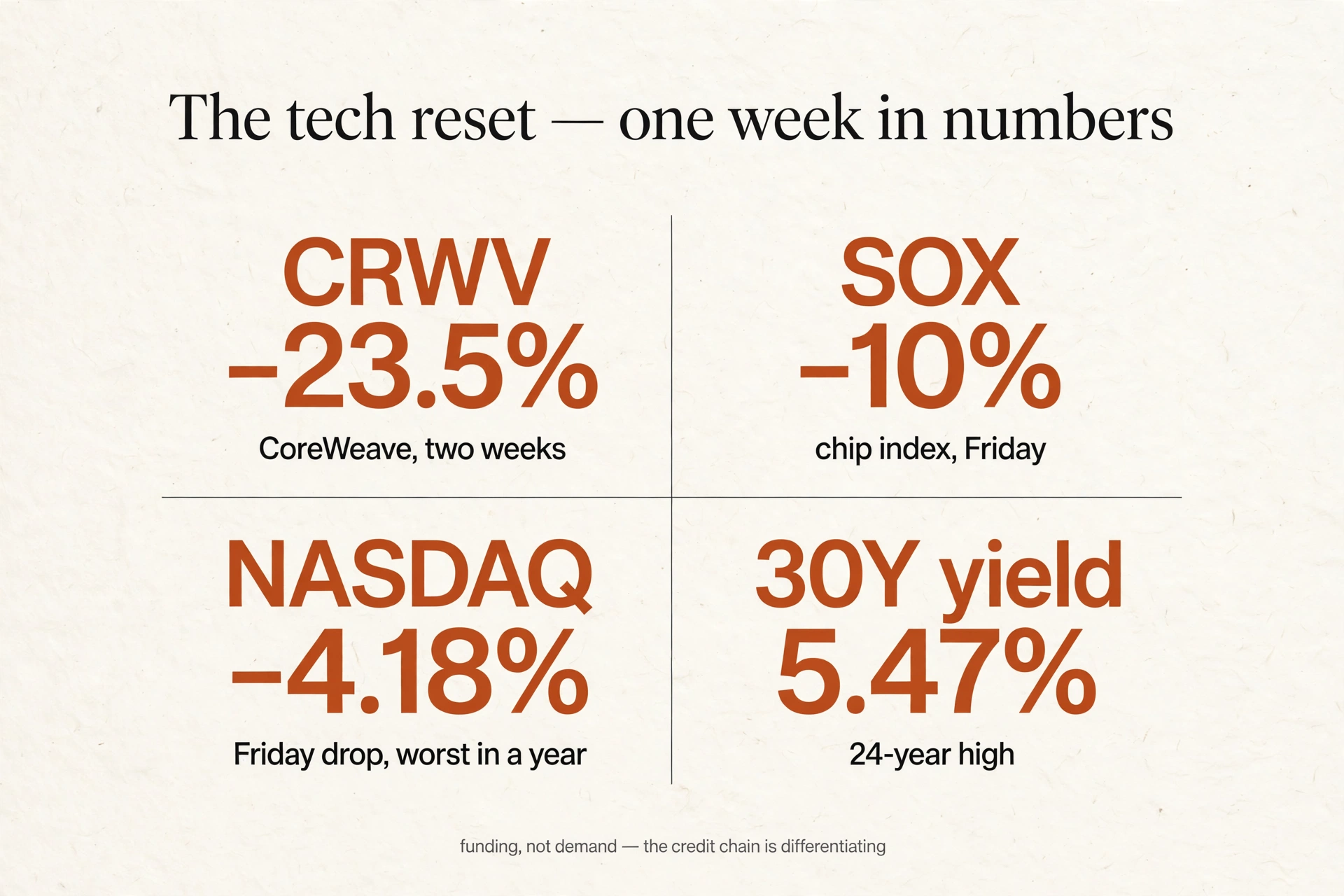
The one thing that matters: CoreWeave is down 23.5% in two weeks, neoclouds have more than halved from their highs, and the chip index fell 10% on Friday — yet every show today landed on the same frame: this isn't "AI is dead," it's funding, not demand. CoreWeave says it's largely sold out; the problem is that the buildout is debt-funded and credit is now charging for it, with hundreds of billions more issuance expected in the next 18 months. The two binding constraints are financing access and power. The tiebreaker is this week: SpaceX reports Tuesday, Meta Wednesday, then the rest of the hyperscalers — and whether their 2027 capex guidance holds. As Cramer's episode put it: CoreWeave's real problem is interest rates — the 30-year Treasury sits at 5.47%, a 24-year high, and "if it breaches 6%, the dominoes fall."
Bloomberg: The Big Take
"What CoreWeave's Selloff Says About the AI Economy" (Oct 19) — host Sarah Holder with Katherine Schwarz (Bloomberg credit reporter) and Dina Bass (AI infrastructure). Full transcript via auto-captions.
- The spark: CoreWeave fell 17% last Wednesday after a co-founder said the company was exploring investment-grade borrowing to tap "unlimited pools of capital" — lenders read it as more leverage on already-high debt with low interest coverage.
- Neoclouds = AI-only clouds built on Nvidia GPUs (CoreWeave, Nscale, Volta). Unlike the hyperscalers, they have no diversified cash-cow business — they fund capex with debt, a project-financing model borrowed from commodities.
- It's contagion, not a single-stock story: Volta's $5B leveraged loan priced at one of the highest rates ever for an AI buildout; UK-based Nscale was pressured to lower its IPO valuation (a ~$30B target toward $19B or even $15B); an Australian Nvidia-backed neocloud IPO was pulled. Investor fatigue over data-center debt oversupply is setting in.
- Demand is not the problem. CoreWeave says it's largely sold out and AI compute demand remains very high. The wall of supply is the issue: hundreds of billions more in issuance is expected over the next 18 months, and investors are moving to the sidelines.
- The Nvidia entanglement cuts both ways: Jensen Huang defended CoreWeave (Nvidia invested $2B in it this year) — but that intertwinedness feeds circular-financing concerns. CEO Michael Intrater says the backlog more than supports the debt; the market wants to see it.
The day's market callFOMO has flipped to skepticism on AI-infrastructure debt. Watch whether hyperscalers' 2027 capex guidance holds — that's what separates a funding reset from a demand problem.
Tickers: CRWV, NVDA
Bloomberg Surveillance
"Bloomberg Surveillance 10/19/2026" (TV edition) + radio podcast edition; hosts Jonathan Ferro, Lisa Abramowicz, Annmarie Hordern. Full transcripts via auto-captions.
- Max Kenna (HSBC): the AI-bubble-burst calls are focused on the wrong factors. The debt-issuance anxiety is overblown; the real 2027 question is the hyperscaler free-cash-flow trough. Optimistic on the tech trade for 6–12 months — stay risk-on.
- Peter Sheer (Academy Securities): cautious. The selloff starts in "compute space" credit; downside-tail risk now outweighs the upside and liquidity could cascade ("idiosyncratic until it's not"). Three open questions: funding, whether AI works as advertised, and how durable the first-mover advantage is.
- Chris Harvey (CIBC): doubling down on his 8,020 year-end S&P call, picking up longer-term core positions in the AI trade, and watching attention turn to industrials.
- Aditya (BofA): the FOMC was on board with two hikes this year — do the second one in October to keep December optionality. The market wrongly assumes a dovish Fed; new Chair Kevin Warsh may actually deliver the promised "sea change," including no forward guidance. Only ~4–5 bps is priced for October, six days before the midterms. Risk: tacitly allowing inflation above 2%.
- Angelo Zeno (CFRA): the Nscale IPO valuation pressure shows AI infrastructure's two binding constraints — financing access and power. The neocloud business model is under stress.
- Kelly Kowski (MassMutual): too early to call peak AI; hyperscaler 2027 capex indications this earnings season are the key data point.
- Rich Greenfield (LightShed): Meta's "Muse" personal-AI platform returns Meta to its utility roots and is winning consumer trust — ahead of Meta's Wednesday earnings.
- Sarah Kun (Cleo Capital): Musk is great at selling big ideas but execution and revenue lag — and it matters because public markets are losing faith in the AI trade. SpaceX reports Tuesday.
- Tobin Marcus (Wolfe Research): the Ukraine conflict is intractable; Ukraine's refinery strikes have widened crack spreads and diesel prices — a politically salient issue pre-midterms — and diplomacy has little chance of an outcome.
- Elsewhere on the show: weekend riots in France over the cost of living (Macron urges calm, no state of emergency; yellow vests to protest Saturday); Cook Political's Jessica Taylor notes Biden approval at a record low 33%, with Democrats increasingly well-positioned to regain governorships. Monday morning: S&P futures +0.4%, Nasdaq +0.25%; 10-year ~5.1%, 2-year ~4.75%.
The day's market callA split desk: bubble-skeptics in credit vs. dip-buyers in equities. The tiebreaker is the same one everywhere — hyperscaler earnings and 2027 capex guidance, starting with SpaceX on Tuesday and Meta on Wednesday.
Tickers: META, NVDA, AAPL, GOOGL, MSFT, AMZN, CRWV
Mad Money
"Mad Money 10/19/26 | Audio Only" — Jim Cramer; full transcript via YouTube auto-captions.
- The open (39th anniversary of the 1987 crash): Friday's selloff may have been a mini hedge-fund blowup — "situational awareness" liquidation like July's — not fundamentals. Monday: Dow −36.38, S&P +0.4%, Nasdaq +1.11%. "Don't take every big move at face value."
- Last week's tech-wreck recap: Monday (Columbus Day) — Broadcom CEO Hock Tan warned that capital, not chips, may be the biggest AI-buildout constraint. Wednesday — CoreWeave cratered 15%+: Musk tweeted "Yikes" about its ~15% bond yields, and an FT piece detailed the co-founder's bid for insurers' "unlimited pools of capital." Thursday — stabilized on Jensen Huang's seal of approval. Friday — full panic: VIX 16 → 22, Nasdaq −2.15%, worst since July 23.
- Damage assessment: Neoclouds crushed — NBIS −25%, and CRWV, IREN, HUT, APLD, CORZ more than halved from their 52-week highs; Nebius is down 43% from its June high. Memory/storage: MU, SK Hynix, WDC, STX down 15–20% (WDC −50% from its highs). Fiber optics: Lumentum and Coherent −25%, Corning −15%. Semicap (AMAT, KLAC, LRCX, ASML) fell 8–19% despite a strong ASML quarter. The chip index broke an 8-day losing streak Monday. Hyperscalers were spared except SpaceX and Oracle; AMZN bounced 12 points on a Morgan Stanley upgrade; AAPL gained 2% last week — "own it, don't trade it" (iPhone Duo).
- Four things before bottom-fishing is safe: (1) charts improve — break the double-tops, Nasdaq back above the 50-day; (2) hyperscaler earnings maintain capex (SpaceX Tuesday, Meta Wednesday, then GOOGL/MSFT/AMZN); (3) midterms in the rearview mirror (data centers are politically toxic pre-election); (4) a successful Anthropic IPO (November, possibly December) to prove the spending chain is profitable.
- CoreWeave's real problem is interest rates, not the balance sheet. The 30-year Treasury is at 5.47% — "if it breaches 6%, CoreWeave can't raise money and the dominoes fall." Fed Chair Warsh is determined to crush inflation. Nebius and IREN worry him more than CoreWeave.
- Lightning Round: SoFi (SOFI) — no; bank stocks need to rally first. Allstate (ALL) — incredibly cheap, don't chase. AppLovin (APP) — no; in Alphabet/Google crosshairs. Vale (VALE) — likes it (copper). MFA Financial — "unequivocally do not own." Kratos (KTOS) defense — won't touch. Twilio (TWLO) — valued correctly. Cintas (CTAS) — great company, buy on pullback.
- Paychex CEO interview (John Gibson): the PEO/HR-advisory segment grew 12% — double expectations; the Wise AI engine, a new agentic-AI compliance tool ("650"), WiseHire, and a Microsoft integration. SMB demand is solid: small businesses want AI plus human advisors.
The day's market callDon't bottom-fish the AI complex until the four conditions are met — charts, hyperscaler capex, midterms, and the Anthropic IPO. Until then, 30-year yields near 5.5% are the tripwire to watch.
Tickers: CRWV, NBIS, IREN, HUT, APLD, CORZ, MU, WDC, STX, LITE, COHR, GLW, AMAT, KLAC, LRCX, ASML, NVDA, AVGO, MSFT, AMZN, GOOGL, META, AAPL, ORCL, SOFI, ALL, APP, VALE, MFA, KTOS, TWLO, CTAS, PAYX
Schwab Market Update
Partial — Friday's closing edition via schwabassetmanagement.com; today's written morning article not up yet in the search index.
- "Chip Stocks Plunge, Putting Wall Street on Defense" (Friday close): the SOX fell 10% Friday on disappointing Broadcom (AVGO) guidance plus rising Treasury yields after strong May payrolls (172K vs. ~85K expected, prior months revised up 93K) — fueling rate-hike fears.
- Friday's numbers: S&P 500 −2.64% to 7,383.74; Nasdaq −4.18% to 25,709.43 (worst week in more than a year, −4.6%); Dow −1.35% to 50,866.78. VIX +28%. The 10-year jumped 6 bps to 4.54%; the 2-year to 4.16%, its highest since early 2025. Odds of at least one Fed hike in 2026 above 70%.
- The call: Friday looked like a leadership reset, not broad liquidation — breadth was orderly (54% of the S&P above its 50-day), with rotation into staples, healthcare, utilities, and financials. Technical support at 7,330 (mid-May low); 7,500 breached. Expect choppy trading ahead.
- Monday pre-open preview: tech and chip stocks bouncing back; Q3 earnings this week headlined by SpaceX, Meta, and Tesla; PPI data today for inflation insight; Bitcoin fell below $60K on Friday for the first time since October 2024.
Tickers: AVGO, MU, MRVL, NVDA, LULU, PG, ALL, KO, TRV, AAPL
Fidelity Market Sense
No new episode
Nothing new since the Oct 6 edition ("This Has Happened To Stocks 95% Of The Time After Midterms"), covered in the Oct 7 digest. Fidelity drops Tuesdays. Data point from Fidelity's Oct 19 Wealth Management Market Roundup: September annual inflation 3.7%, core 2.6%; gasoline (+9.1%) drove September price gains; the wealth effect is still supporting spending while small-business optimism weakened.
Fast Money
Skipped
No free caption source — standing rule; never summarized from headlines.