Treasury auction day is back.
Built from tonight's finance podcast transcripts — what the shows actually said, paraphrased, never invented. Sources that weren't available are marked inline.
Schwab Market Update
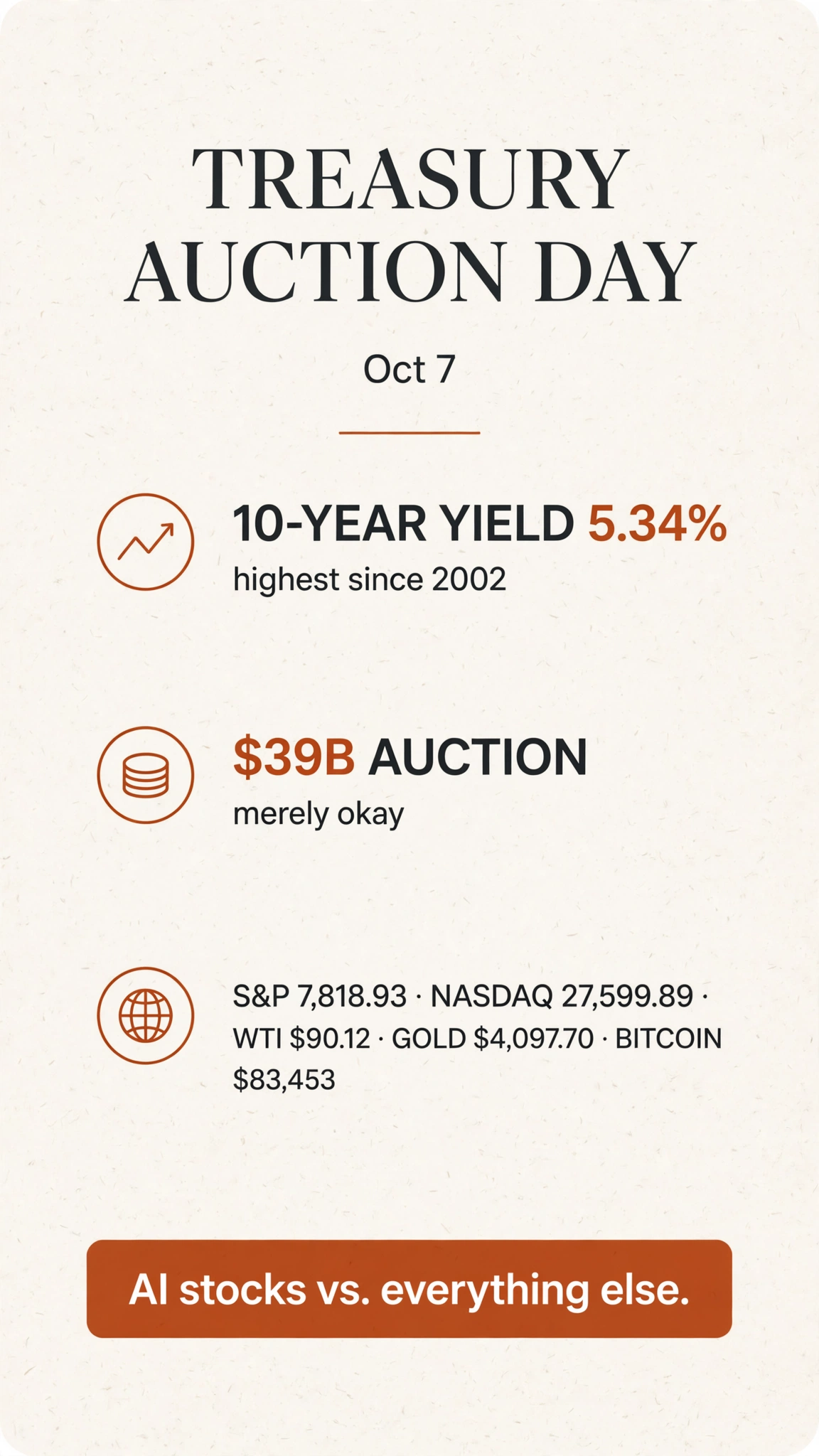
- Pre-open snapshot (Tuesday close levels): S&P 500 7,818.93 (+0.58% — closed above 7,800 for the first time Tuesday), Dow 51,521.28 (+0.49%), Nasdaq 27,599.89 (+0.45% — fresh records), 10-year 5.34% (+0.07), dollar index 102.49, VIX 15.76 (+5.00%), gold $4,097.70 (−2.14%), WTI crude $90.12 (+0.76%), Bitcoin $83,453 (−2.44%). Stocks were set to open lower Wednesday as oil and yields set the tone.
- The 10-year note touched its highest level since 2002, a day after the S&P and Nasdaq closed at record highs.
- Today's $39B 10-year auction is the one to watch — Tuesday's 3-year auction brought the highest yield since May 2006.
- Nathan Peterson (Schwab Center for Financial Research): if the 10-year resumes its upward bias and notches fresh cycle highs, "this could keep a lid on stocks" — but if yields and oil just stabilize, that's "good enough" for the bulls, at least from a trading perspective.
- The earnings calendar picks up: PepsiCo (PEP) tomorrow, Delta Air Lines (DAL) Friday.
Bloomberg: The Big Take
YouTube auto-captions hit YouTube's 429 rate limit — no retry per standing policy. The episode is a midterms/politics story (MAGA money in Texas races), not market content, so it gets the description-level treatment: no market call to summarize.
Bloomberg Surveillance
- The day's thesis: everyone is bidding for the same capital — the Treasury gearing up to auction long-term debt, SpaceX's $40B Nvidia-chip raise, governments borrowing $2T again, $30–40B debt deals landing any day in any currency. And yet, with yields at their highest since 2002, "none of these companies are slowing down."
- France: bond selloff over deficit concerns; the Banque de France head (an ECB council member) said the ECB exists to fight inflation, not fix countries' fiscal problems — "if you're waiting for the ECB put, it is not coming."
- Mark (rates): a broad global reassessment of where the neutral rate is. New Fed Chair Warsh said at Jackson Hole he was "hard-pressed" to describe financial conditions as restrictive — a meaningful hawkish shift in guidance.
- Claudia (Fed): the dot plot looked like risk management — most of the committee sees one more hike, some see two. This is supply-driven inflation, a different animal from the demand-driven kind the Fed is used to.
- Vishal (Treasury supply): a genuine supply/demand imbalance — the Treasury took out 30% of net float of long-end supply; investors are pushing back, and the average maturity of the debt is slowly shrinking on them.
- Scott: "oil is the linchpin — as goes oil, so goes inflation expectations and with it rates." New highs need both halves of the market cooperating: cyclicals and defensives plus the AI cohort — and the cyclical half needs oil lower.
- Eric (AI and jobs): there will be more jobs ahead than today — but many millions of jobs will change over the next decade. The #1 job posting in Silicon Valley right now: software developers — they're the ones helping AI write the code.
- Aaron (credit): investment-grade spreads haven't budged despite record issuance; the SpaceX–Nvidia news shows higher cost of capital isn't pausing the AI buildout. The open question: how much higher can borrowing costs go before capex decisions change?
- Mitchell (AI monetization): consumer AI agents are exploding — Meta's Muse, Anthropic, OpenAI — and every platform (Amazon, Walmart, everyone) is racing to monetize them. This is the path the buildout is betting on.
- Simon (Nvidia bull, $515 price target): Nvidia is "a key anchor" of an industrial revolution — no binary thinking needed; open and frontier models, hyperscale and neocloud can all win. Memory-supply constraints are long-lasting, but demand is growing even faster.
- Olivia (the behind-AI trade): power, grid, gas demand — the underinvestment parallel to late-'90s oil & gas infrastructure. $20B already deployed into the energy side of the AI story.
- Yahaira (stocks): Intel rising, TSMC falling — Musk clarified the Texas chip project: his companies build and operate it, Intel helps develop the technology, TSMC could potentially lease parts. JetBlue got FAA approval for Spirit's LaGuardia slots.
- Tyler (Hormuz): Iran's new wave of attacks — 9 ships hit so far in October, half of September's total — even as US crude exports approach pre-war levels. Refined products and diesel still lagging.
- Tobin (midterms): Democrats need at least two seats that went for Trump by wide margins; the path runs through "very red territory." The blue shift is biggest in the reddest places — but expectations may be getting ahead of the polling.
- Henrietta (policy): watch Senate Finance and House Ways & Means — a Democratic Congress would roll back R&E expensing and bonus depreciation from the One Big Beautiful Bill. Data-center tax breaks are unpopular with the voters living next to the data centers.
- News roundup: HSBC reportedly cutting half of UK wealth-management leadership and 70% of financial advisors, pushing AI to serve clients; a suspected plague case in Siberia (a research-institute worker died, contacts under observation) — Trump says he'll speak to Putin.
Mad Money
- The frame: "we used to just sit on our hands until we got the Treasury bond auction results... we're doing it again." Today's $39B 10-year auction was okay but not inspirational; the Dow, S&P and Nasdaq all drifted ~0.2% lower.
- Two classes of companies: the vast majority of the S&P — old-school, credit-dependent, hostage to every auction — vs. the "sainted" AI companies that borrow near Treasuries no matter what. SpaceX (BBB-rated) raising $40B for Nvidia chips will pay barely over Treasuries; Paramount/Skydance (BB) issued a similar amount at ~8% and the bonds got "clubbed" immediately. "AI data-center stocks have nothing to do with what price the federal government borrows at."
- Goldman on SpaceX: reiterated buy, raised the price target $220 → $230. Cramer says the bump "ratified" the earlier number — when price targets rise on speculative names before the hot money arrives, "maybe there really is some rigor to the analysis." SpaceX renting out compute is so profitable it could become Nvidia's largest client.
- Price-target lesson: when analysts raise targets en masse after a stock sells off, "that's a sign that the stock probably shouldn't be going down at all." Measure the disparity between analyst coverage and the stock's performance — that's the entry signal.
- Levi Strauss (LEVI): a technically mixed quarter Cramer called positive — small revenue miss (currency), big EPS beat (tariff refunds), full-year guide raised. Wholesale +6%, international +8%, DTC +2% (weak in Europe/US, rebounding in September). CEO Michelle Gass interview; Cramer sees a Constellation-style "things got better" rally setup.
- Constellation Brands (STZ): +2% to $118 on "much better than feared" — net sales +6% YoY, EPS beat by ~$0.35, beer shipments +5.5%. Modelo Especial depletions −2% and Corona Extra −5%, offset by Pacifico +19%, Victoria +15%, Modelo Chelada +5%. Guidance reiterated, high end possible if September trends hold. Headwinds named: GLP-1 drugs, cannabis legalization, the immigration crackdown hitting its Hispanic customer base, high gas prices.
- Veeva Systems (VEEV): +15% in a session on the August quarter, ~+50% in three months; now competing with Salesforce for pharma CRM — won business from Eli Lilly, Amgen, Biogen, Regeneron — and using AI for customers itself. The "vibe coding will kill Veeva" thesis had "not one ounce of truth." CEO Peter Gassner interview.
- Lightning round: swap Western Digital for the cheaper Micron (MU); Vertiv (VRT) good on data-center weakness; GE Vernova for full soup-to-nuts power; likes L3Harris (LHX) ~$230 — scale in; GigaCloud (GCT) "one of the most speculative stocks on earth"; Archer Daniels (ADM) at ~14x forward earnings with a 5% yield — "its time has come" (also likes Deere); B&W (BW) at ~$5 a "nice speculation." Pass on the Medtronic spinoff and on ResMed (no catalyst).
Fidelity Market Sense
No free transcript: media.fidelity.com PDF pattern 404s, fidelity.com is JS-walled, and the YouTube upload carries no captions. Description-level: a midterms-season episode — elections dominate the headlines; Fidelity's team covers the financial policy issues shaping the 2026 midterms (taxes, trade, government spending, regulation) and how markets have historically performed around midterm elections.
Fast Money
No free caption source — standing rule; never summarized from headlines.