Daily Market Digest · Thursday, October 1, 2026
High yields aren't fear. They're growth expectations.
Built from tonight's finance podcast transcripts — what the shows actually said, paraphrased, never invented. Sources that weren't available are marked inline.
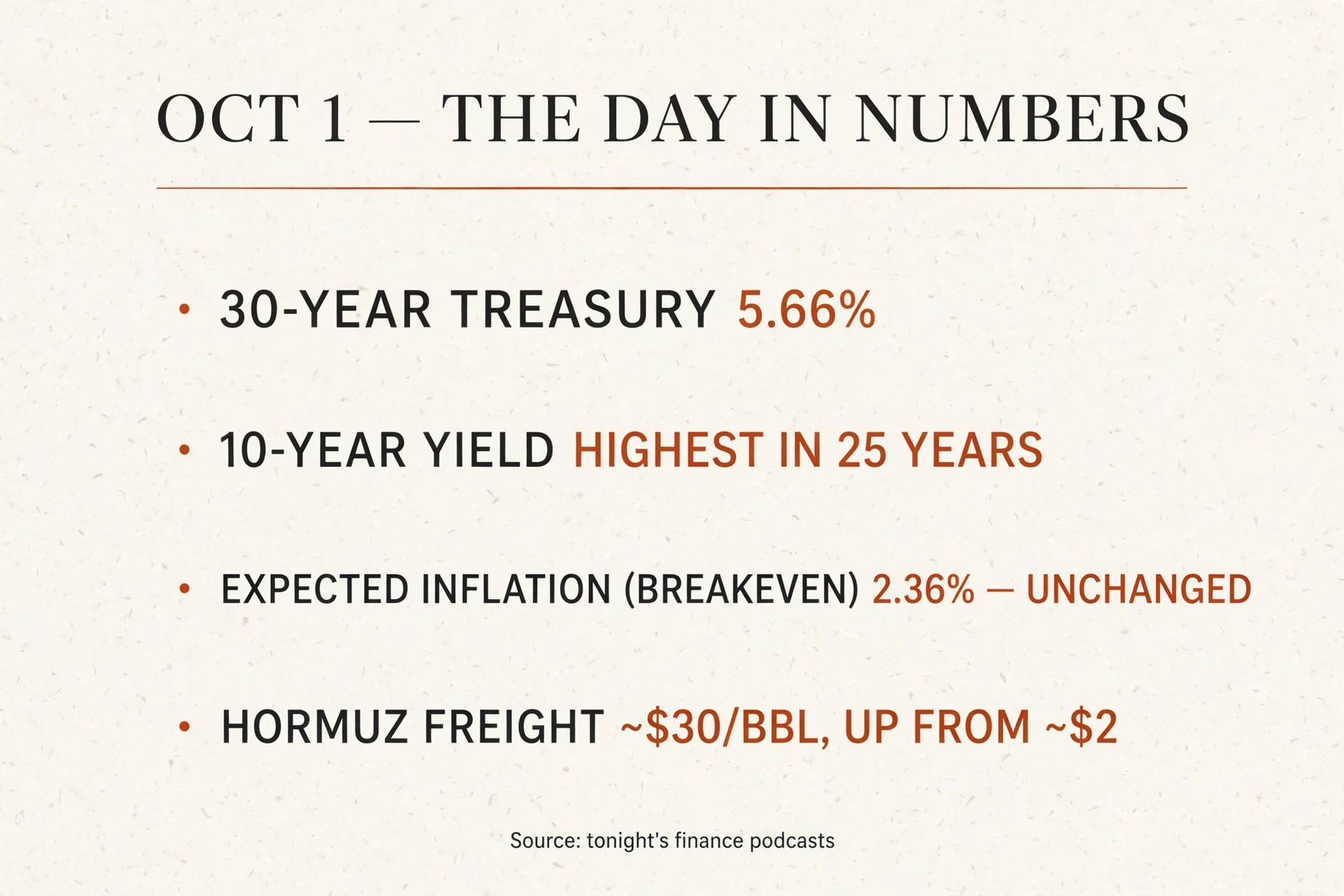
The one thing that matters: Duke's Cam Harvey told Bloomberg the 10-year's 25-year high is being misread — breakeven inflation sits at 2.36%, exactly where it was a year ago, so the surge is in real yields, which track expected real growth. In plain terms: rates are high because the market expects the economy to grow, not because it fears inflation or a US default. The catch is everything priced off those yields — McDonald's got a full Mad Money autopsy tonight as a 3.3% dividend that can't compete with a 5.24% risk-free rate — and Hormuz freight at ~$30 a barrel (vs ~$2 a year ago) keeps taxing every refined product. Friday's payrolls report is the first real test of the "it's growth" story.
Schwab Market Update
Thursday, Oct 1 · Schwab transcript not up yet — schwab.com is behind its bot wall and the search index still carries the Sep 30 edition ("Inflation Growth Slows, Sending Stocks Up Early"). No Schwab summary tonight; nothing invented in its place.
Bloomberg Surveillance
Thursday, Oct 1 · Radio podcast, "The Yield Curve and Shipping Risks." Full transcript via official Bloomberg Podcasts YouTube auto-captions. Guests: Cam Harvey (Duke Fuqua), Kate Luft (Citi retail banking), John Kartsonas (Breakwave Partners).
- Perspective on yields: the 10-year is statistically the highest in 25 years — but only ~average over longer history. The abnormal era, per Harvey, was 1% rates and 2–3% mortgages, not today.
- It's not inflation: breakeven expected inflation is ~2.36% and has not moved in a year — not even since the strikes on Iran began, despite $6+ diesel.
- It's not default fear either: a US default would come via money-printing, which would show up in inflation expectations; corporate-to-Treasury spreads haven't moved.
- What moved is real rates: expected real yields have risen, and Harvey's research ties real rates to expected real growth — "the reason rates are going up is because of higher expected real economic growth."
- Value/growth rethink: index construction stuffs expensive, low-growth stocks into "growth." His fix: invest in actual growth — sales growth, R&D growth — not the label.
- Shipping is the inflation channel: Kartsonas's BWET is the top-performing ETF of 2026, but Hormuz freight at ~$30/barrel (vs ~$2 a year ago) is "not sustainable." The pain lands in refined products — diesel and gasoline — not the crude price. Simultaneous disruption in the Red Sea, Arabian Sea, and Black Sea is, in his word, unprecedented; diesel into winter is the worry, and refinery damage won't heal overnight.
- Retail banking: Citi's Luft pitched relationship banking over yield-chasing — and noted ~73% of Gen Z clients still want a physical branch, because they don't yet know what questions to ask.
The day's market callIf Harvey is right, generational yields are a growth signal wearing a scary costume. Friday's payrolls number either validates that — or exposes it.
Tickers: TNX (30-year at 5.66%), BWET, C.
Bloomberg The Big Take
Thursday, Oct 1 · "The Man City Scandal Rocking the Premier League." Host David Gura with Giles Turner, Bloomberg's business-of-sports editor. Source: episode description and transcript via podscan.fm.
- The verdict: the Premier League found Manchester City guilty of artificially boosting its financial results by more than £900 million over nine years, using "sham" contracts to build an unprecedented competitive advantage.
- How we got here: City were a footnote next to Manchester United until an Abu Dhabi-backed vehicle bought the club in 2008 — "almost overnight, their fortunes changed," and the rise was stratospheric.
- Why it stings: as Turner puts the fan logic — if they'd cheated and won nothing, everyone would laugh. They won everything. That's what makes people upset.
- The clock: the club has until Oct 2 to respond to the charges.
- What's at stake: potential punishments that could reshape the entire league — and a wider reckoning for how state-linked money and club finances interact across European football.
The day's market callA decade of dominance just became a balance-sheet question: what is a title worth if it was bought off-book — and who else in the league gets repriced when the answer lands?
Tickers: none — sports-business edition. Key figures: £900M+, nine years, Oct 2 response deadline.
CNBC Mad Money
Thursday, Oct 1 · "Mad Money 10/01/26 | Audio Only" (CNBC Television). Full transcript via YouTube auto-captions.
- A sedate open to Q4: Dow +21 points (+0.19%), Nasdaq +0.04% — a rally that stalled when reports of a third carrier group heading to the Gulf hit the tape and froze a "much-needed" bond rally.
- Q3 scorecard — winners: S&P 500 +2.03% on the quarter. Moderna was the index's story stock (melanoma vaccine with Merck); Everpure +66% as a Meta storage/hyperscaler play; Veeva +61% leading the "SaaS apocalypse" bounceback — though Cramer prefers Salesforce (the Dow's best, +46.5%, plus an Anthropic partnership) and would still buy Palantir near $190 against his $250 target.
- Q3 scorecard — losers: Fair Isaac −50% (the FHFA wants FICO competition — though the banks he surveyed still trust it), AppLovin −44% (Android moved in), Corning −40% on profit-taking (he'd buy dips: fiber, not copper, is the data center's future), KLA −35% despite the chip shortage, Rocket Lab −31%.
- Microsoft's "just beginning": +37.5% in Q3 but only ~6% for the year — Copilot "on fire," Azure accelerating, early data-center profitability. Dow laggards Caterpillar (−24%, data-center engines — maybe a buy) and IBM (−22% after a miss: his rule is wait a quarter).
- The McDonald's autopsy: down 24% this year after a panned investor day. The turnaround costs ~$800k per drive-thru ($8.5B of corporate support through 2036), franchisees must be wrangled, and a 3.3% dividend yield can't compete with a 5.24% 10-year. At ~18x earnings — cheapest since 2014 — it's a "show-me stock," but he's a tempted buyer, not a seller.
- The AI-plumbing trade: AI agent traffic has already passed human traffic (Cloudflare's Matthew Prince), and the content-delivery networks are ripping — Cloudflare +121% from its low (but 279x earnings: wait for a pullback), Fastly +159% YTD (~50x: least confidence). His one buy-it-now name is Akamai at under 16x — its $11.6B, seven-year Anthropic inference deal (~$1.66B/year) is "basically free" after the stock gave back the pop.
- Fermi, one year on: the AI data-center IPO he warned against at $21 is ~$4, down 89% from its peak — soft-commitment customers pulled out, losses widened, a dilutive convertible followed. "More of a business plan than a business" held up.
The day's market callQ3's lesson, per Cramer: own what AI actually uses — bounced-back software and the internet's plumbing — and make rate-sensitive yield stocks earn their place against a 5.24% risk-free alternative.
Tickers: MRNA, MRK, CRM, PLTR, FICO, APP, GLW, KLAC, RKLB, MSFT, CAT, IBM, MCD, NET, AKAM, FSLY, FRMI, CRWV, AXON, MDT, MS.
Fidelity Market Sense
Weekly (drops Tue) · No new episode — the latest remains Sep 22, "The biggest ETF trends investors should know now." Nothing to summarize tonight.
CNBC Fast Money
Skipped — no free caption source for tonight's episode (standing rule: never summarize from headlines).