Daily Market Digest · Wednesday, September 23, 2026
Crude held the tape today. Tomorrow's Trump–Xi summit holds the week.
Built from tonight's finance podcast transcripts — what the shows actually said, paraphrased, never invented. Sources that weren't available are marked inline.
The one thing that matters: Oil is steering the market ahead of Thursday's Trump–Xi summit — WTI at $90.76 pushed stocks and Treasuries around this morning, with the 10-year yield back to 4.99% as the Fed's hike path stays in focus. Under the hood, breadth is weak: the S&P 500 was flat while only 5 of 11 sectors rose and more stocks made new lows than highs. One full transcript tonight (Schwab) — YouTube captions were rate-limited across Bloomberg's shows and Mad Money, so those are marked honestly below.
Schwab Market Update
Wednesday, Sept 23 · Morning edition (9:11 a.m. ET) — "Crude in Control: Stocks Stumble as Diplomacy Eyed." Schwab's written daily article, full text.
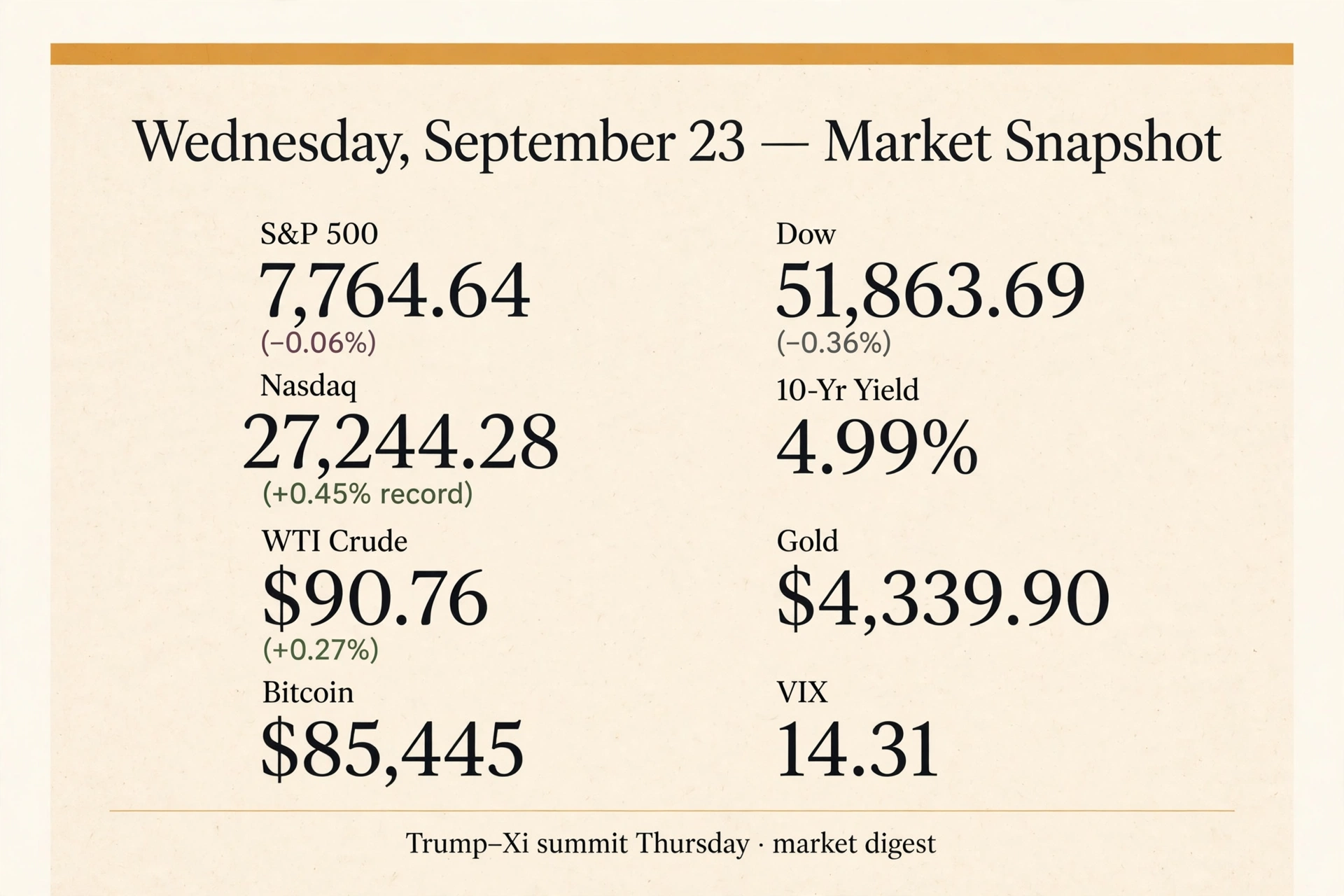
- Morning tape: S&P 500 7,764.64 (−0.06%), Dow 51,863.69 (−0.36%), Nasdaq 27,244.28 (+0.45%). 10-year Treasury yield 4.99%; Dollar Index 100.96 (+0.36%); VIX 14.31; gold $4,339.90 (−0.83%); WTI crude $90.76 (+0.27%); Bitcoin $85,445 (−0.98%).
- Crude in control: oil ticked up overnight on diplomacy headlines, pressuring stocks and Treasuries early in the session.
- Diplomacy dominates: Iran's president addressed the UN today; Trump threatened Iran in a UN speech yesterday but noted lower-level talks are underway. Trump meets Xi at the White House tomorrow, with trade the likely topic.
- Tuesday's recap: the Nasdaq forged record highs while the S&P was flat — but only 5 of 11 sectors rose, and more stocks made new lows than highs. Breadth is weak under the hood.
- Fed watch: Governor Michael Barr speaks today on the economic outlook. Schwab's Cooper Howard: "We expect the Fed to hike one more time this year and again either later this year or early next year."
- Light data: September S&P Global U.S. Manufacturing PMI (consensus 53.6, last month 53.9 — above 50 means expansion).
The day's market callOil and geopolitics are running the tape. Rates stay biased upward on the hike expectation, while equity leadership keeps narrowing — a setup that needs Thursday's summit to deliver.
Tickers: WTI, 10Y, DXY, VIX, BTC. No individual-stock calls in today's edition.
Bloomberg The Big Take
Wednesday, Sept 23 · No confirmed 2026-09-23 main episode found. Big Take Asia uploaded "Is the US AI Reckoning an Opportunity for China?" on YouTube, but captions were unavailable (rate-limited) — so there's nothing to summarize without inventing it.
Big Take transcript not up yet — marked unavailable rather than summarized from headlines.
Bloomberg Surveillance
Wednesday, Sept 23 · Episode confirmed: "Bloomberg Surveillance TV: September 23rd, 2026." Full transcript unavailable — YouTube captions were rate-limited today. Guest list from the official upload:
- Aaron Kennon — CEO & Co-Founder, Clear Harbor Asset Management
- Amos Hochstein — Managing Partner, TWG Global
- Juan Londoño — Policy Analyst, Cato Institute
Surveillance transcript not up yet — episode exists, but only the guest list could be retrieved.
CNBC Mad Money
Wednesday, Sept 23 · The "Mad Money 09/23/26 | Audio Only" upload exists on YouTube, but caption download was rate-limited today — no free text source, so the show is skipped rather than summarized from headlines.
Mad Money transcript not up yet.
Fidelity Market Sense
Weekly — drops Tuesdays. No new episode since Week 212 (2026-09-15).
CNBC Fast Money
Skipped — no free caption source (standing rule).